By autumn, Lena and I needed something to look forward to. It had been a rough year, and we wanted an adventure. Egypt appealed because Lena dreams of seeing all the wonders of the world. Turkey was close, and we liked the idea of getting out into nature. Then, rather suddenly, we settled on China. We’d both wanted to go for years, and apparently that was reason enough.
We had two weeks for a country we could spend months or years exploring. I usually prefer deciding for myself where to stop and how long to stay, but we’d enjoyed our guided trip in Cuba earlier that year. So we booked a tour through Beijing, Xi’an, the mountains around Zhangjiajie and Shanghai. Quite ambitious.
Before we left, I still half expected monumental concrete, stern faces, people moving in formation and cameras everywhere. The cameras, as it happened, were real. Most of the rest was not.
The most convenient flights went through Vladivostok, with layovers ranging from six hours to almost a day. Rather than sleep badly on our suitcases in an airport, we decided to spend a day in Vladivostok before continuing to Beijing.
Vladivostok FM
My knowledge of Vladivostok came mostly from Vladivostok FM, the radio station in GTA IV. I knew about the region’s steep hills and spectacular wilderness, but had no clear picture of the city.
We arrived after an overnight flight, keeping up a tradition established on our Cuban honeymoon: begin a holiday with as little sleep as possible. The Aeroexpress turned out to be an ordinary commuter train that someone seemed to have painted to look like an Aeroexpress.
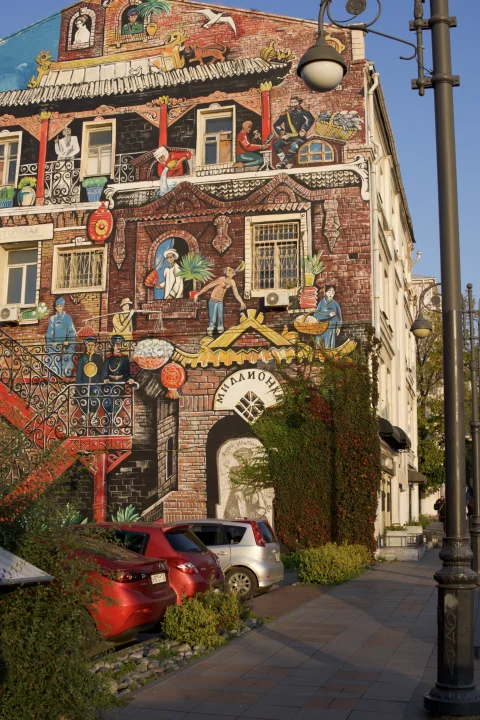
On the way to our hotel, we saw buildings scattered over hills, appearing between patches of forest. A single street can contain a battered Soviet apartment block, an elegant old classical building and something glassy and modern. Oddly enough, it reminded me of my first visit to Rome. Not because a Soviet apartment block resembles a pagan temple, but because of that feeling of different periods piling up on top of one another without agreeing on a plan.
We wanted something local for lunch, preferably involving seafood. Almost next door to the hotel, a restaurant serving regional food offered smoked seal fat on dark bread with onion. Of course we ordered it. It tasted like fat. Good fat, to be fair, but you could probably have served me ordinary pork fat and called it seal, and I’d have been none the wiser. It was the most memorable part of lunch, if only for its biography. I felt sorry for the seal. Then again, better that we eat the seal than the other way around.
Back at the hotel, we collapsed for two hours. Waking up did not improve matters much, but a flat white coffee got us moving again. We walked through the centre towards the waterfront. Vladivostok is pleasant on foot, provided you accept that a route that looks perfectly fine on a map may end at a sheer rock face. We managed to find a couple of those.
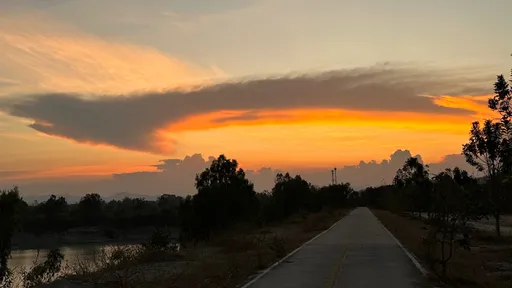
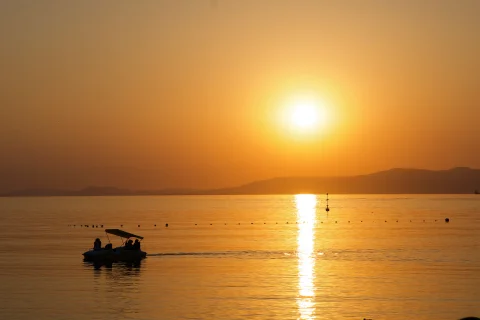
Down by the waterfront, ships crossed the bay beneath the hills. At sunset the sun touched the ridge and disappeared almost at once, as if someone had switched it off. I thought of the coast near Antalya, only this seemed prettier to me. Maybe because that was Turkey, and here the sea felt like our own.
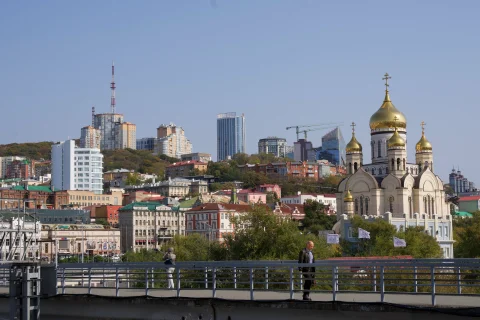
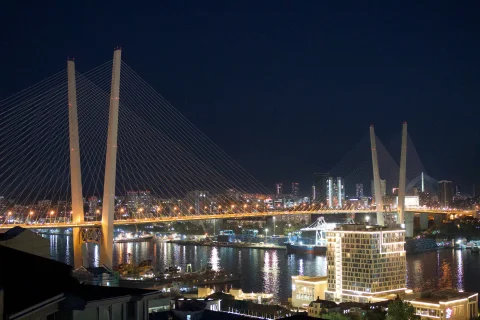
We finished at a viewpoint above the Golden Bridge. By then it was dark, and the path had no lights. Lena worried about snakes. I confidently assured her there were none, despite knowing absolutely nothing about the local snake population.
Below us, the illuminated bridge stretched over the harbour, with the lights of the city and port all around it. It was absolutely worth the climb.
We had come to Vladivostok almost by accident, and I already regretted having only a day. I could imagine coming back for a couple of weeks, renting a car and exploring that coast.
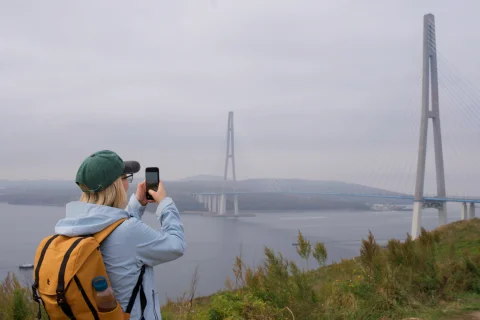
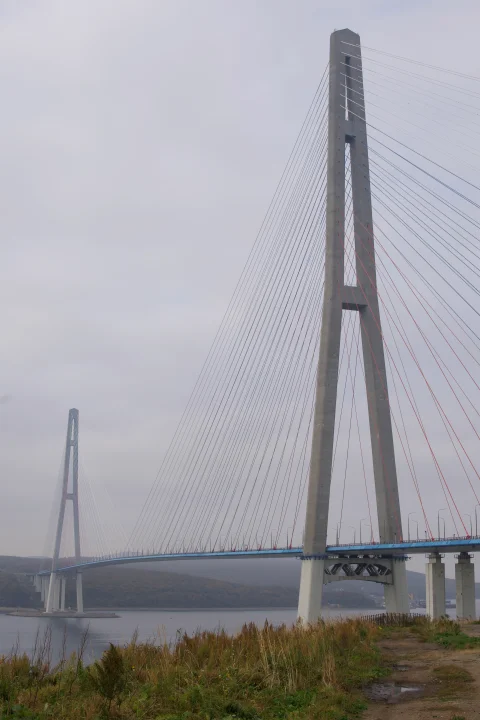
The next morning, before our flight to Beijing, we went to the Russky Bridge, which leads to Russky Island. I remembered hearing about its construction, never expecting to stand beneath those enormous pylons myself.
Near an old coastal battery, we found a ruined viewpoint overlooking the strait. There were almost no people, just abandoned structures, hills and ships moving far below. With all that empty space around us, it really felt as though we’d reached the far end of Russia. Every now and then a loudspeaker announced that stopping there was forbidden and told somebody to leave. We weren’t sure whether it meant us. I had Breaking the Law playing in my head.
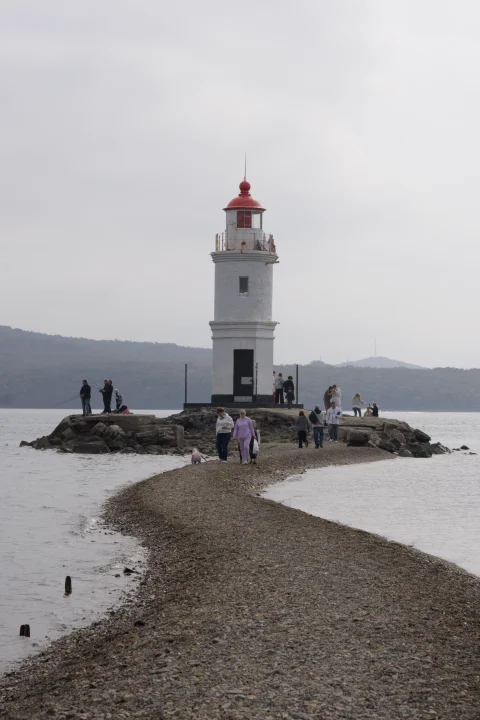
Our last stop before the airport was Tokarevsky Lighthouse. We walked out to it along a narrow causeway. The sea air was wonderful. I had imagined a great dramatic tower; the lighthouse itself turned out to be about the size of a thimble, surrounded by tourists and souvenir stalls.
At the airport we nearly missed our flight to Beijing after settling too comfortably into the World of Luxury and Comfort, as Lena and I call the business lounge. These days, a working bean-to-cup coffee machine is often its main luxury. Eventually we remembered the plane.
Beijing: Emperors, Ducks and Coffee
We reached Beijing late and checked into our hotel, where nobody was going to feed us. So our first expedition into the city was in search of dinner. We found a tiny neighbourhood shop, rather than the gleaming supermarket Lena had imagined. Paying with Alipay, the mobile payment app, took a surprising amount of pointing at screens.
After all that, our first dinner in China was instant noodles and beer.
The next morning, Beijing surprised me before we reached a single attraction. From the bus window I saw broad avenues, wide pavements, trees everywhere and streams of scooters. Some residential streets looked almost like the Zyuzino neighbourhood in Moscow, except the familiar five-storey blocks had grown to six.
Our guide was called Mia, and we liked her. She reminded us of a Budgett’s frog: a small, comical-looking creature with a surprisingly fierce yell. Mia was small, cheerful and quite capable of keeping twenty-seven tourists in line. My ideal group would probably have been just Lena and me, but most of our fellow travellers were fine.
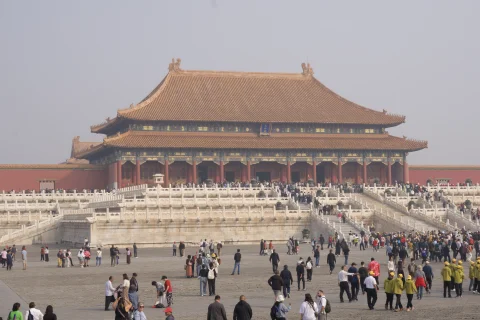
The crowds really hit us at the Forbidden City, the huge former imperial palace complex at the heart of Beijing. It was completed in 1420, during the Ming dynasty.
At first, we walked through vast paved courtyards past buildings that looked remarkably similar: columns, a traditional roof, another hall, another roof. It reminded me of travelling around Europe. At the first church, you’re in awe, running around taking photos from every angle. A week later, you lower the car window, say “Lovely,” and drive on without parking. The crowds, barriers and restoration scaffolding were helping me reach that stage quickly.
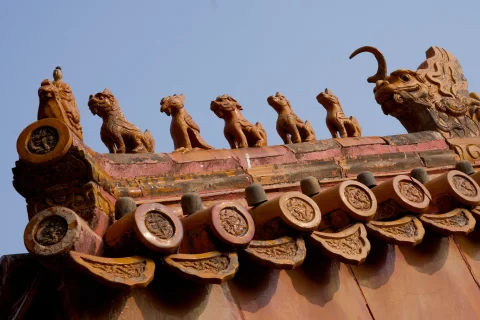
Farther inside, I began noticing the tiny figures along the roof ridges. I photographed them from several angles in the hope of getting one picture worth keeping. Then we reached the imperial gardens: trees, strange rock formations, places you might actually want to sit. The emperor, I decided, had been a clever fellow. He had kept the nicest part for himself.
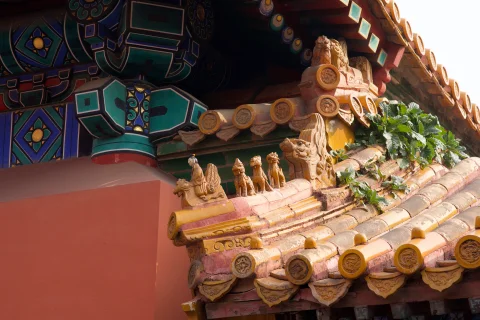
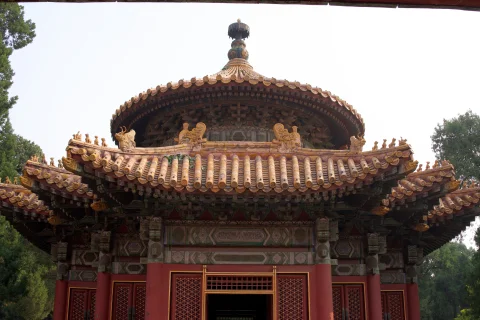
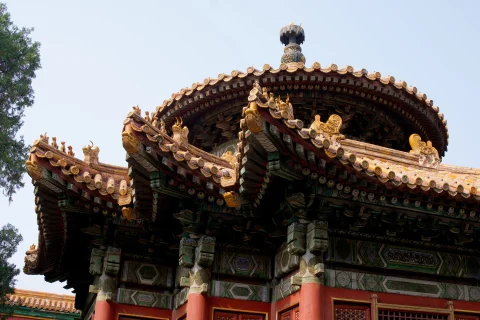
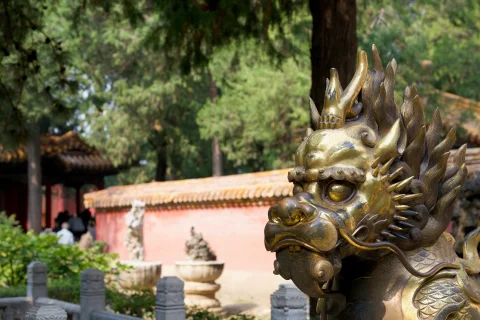
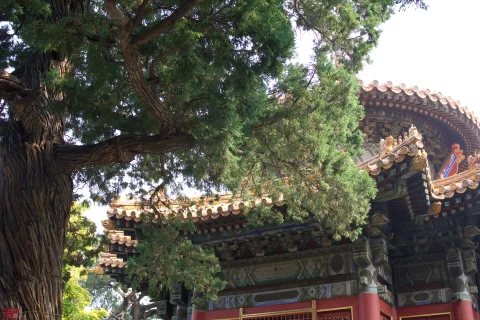
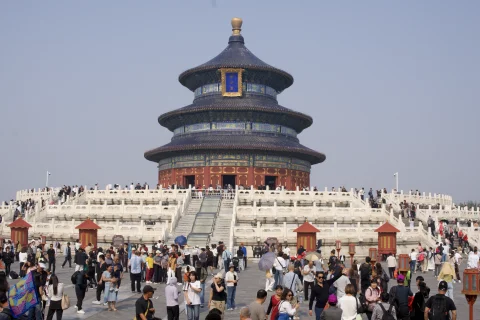
The Temple of Heaven, founded in 1420 for imperial rituals and prayers for good harvests, was beautiful too. But we mostly saw it from outside, and by then another elegant roof wasn’t enough to get me especially excited. On Tiananmen Square, it was the repeated passport checks, rather than the enormous space, that stayed with me. For a place where “nothing happened”, it was remarkably well guarded.
Lunch, though, was quite a show. We sat at a round table with a rotating tray in the middle, where the waiters began setting down dishes for us to share. At first there seemed to be far too little food. Every time a plate appeared, somebody spun it towards themselves and helped themselves with great determination. If you hesitated, it looked as though lunch might disappear before it reached your side of the table.
Then the waiters brought more. And more. Soon we were wondering whether to save room for the next dish. The Peking duck, wrapped with sauce in thin pancakes, was wonderful. With every extra piece of crispy skin, I could almost hear my pancreas filing a complaint.
Mia had promised to help us find coffee, and she came through, taking us to a counter that served strong iced coffee. It was very welcome. Whenever we did find coffee, it was good; we just had to squeeze these stops into someone else’s timetable.
The timetable did have room for a silk factory, where we saw cocoons and got a talk about silk production that lasted perhaps five minutes. Then the educational part ended and we were shown the real attraction: a room full of very expensive pillows, blankets and other things we had apparently travelled across China to buy. I enjoy shopping when I have decided to go shopping. I am considerably less enthusiastic when shopping dresses itself up as a cultural excursion.
We skipped an optional evening show and went shopping instead. This was honest consumerism, and I enjoyed it. While we were out, we discovered dirty coffee: hot espresso poured over very cold milk. I loved it. I prefer coffee with a strong flavour, not something that briefly met a bean on its way to the cup.
On the way back we bought water that was supposed to cost two yuan a bottle, but we were charged three. I would probably have shrugged and walked away. Lena had other ideas. With the air of someone delivering a devastating argument in flawless Chinese, she stepped in. We settled the dispute by taking a third bottle. Justice had been served, and we had rather more water than we knew what to do with.
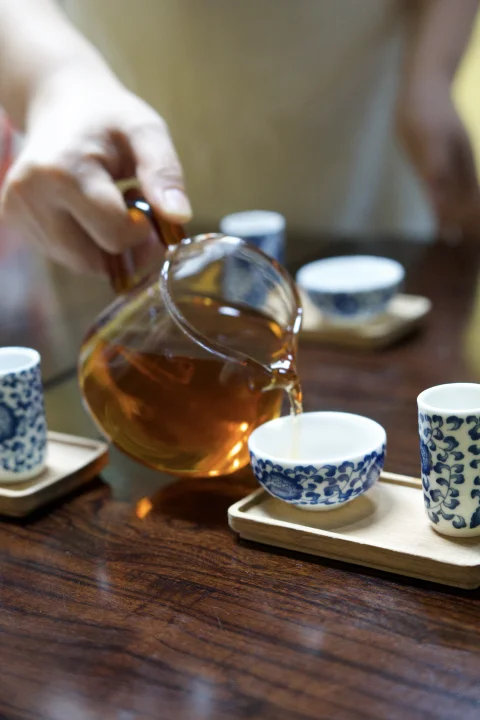
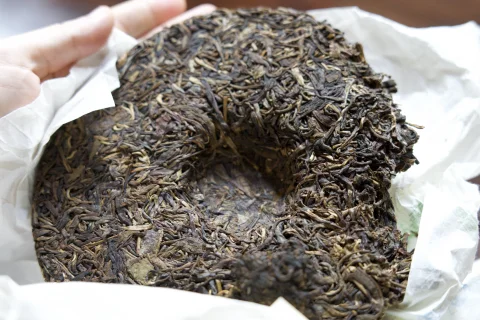
The next morning began with a tea tasting. The tea was lovely, and I could happily have sat there drinking it for quite a while. Unfortunately, the cups were so tiny that I’d have needed about fifty of them. The tea and teapots offered afterwards were priced as if we were buying shares in the plantation.
Forty Minutes on the Great Wall
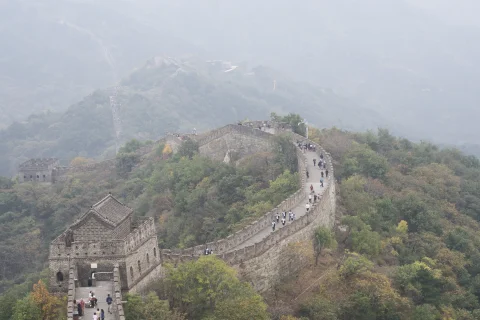
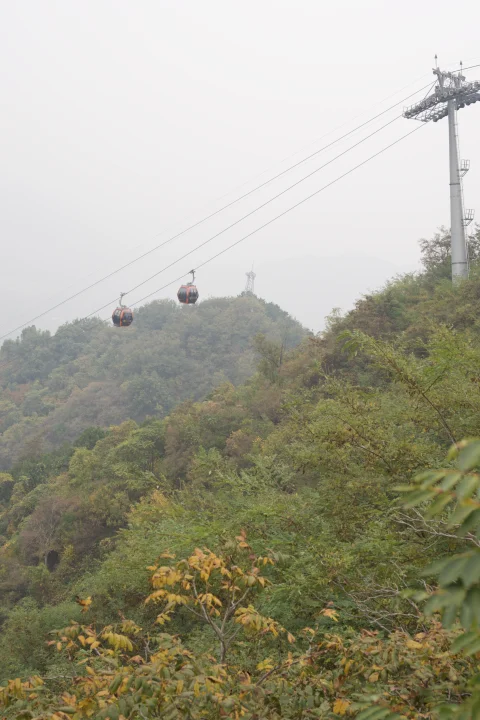
After the tea tasting, we headed for Mutianyu, a section of the Great Wall built during the Ming dynasty (1368–1644). After hours in traffic, we joined queues to get in, change buses and reach the cable car. There seemed to be a queue just to join the next queue. I began to suspect that the entire population of China had chosen the same day to visit the same stretch of wall.
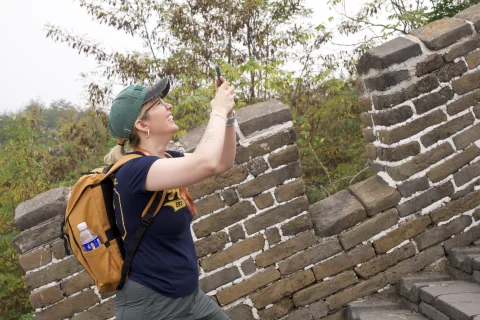
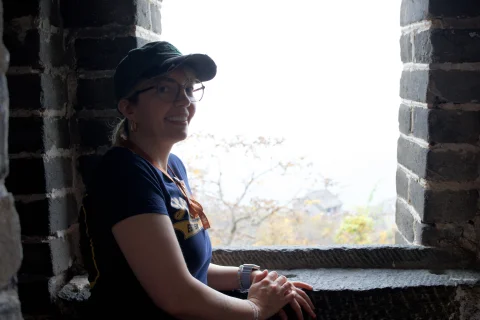
On the ramparts, narrow passages through the towers created human traffic jams. I was standing on the Great Wall of China, a place I had seen in photographs all my life, and was disappointed by how little I felt.
Beyond the first few towers we found a quieter stretch. For a moment I could look ahead without a wall of people in front of me. The fortifications climbed the hills, disappeared into a hazy ridge and reappeared farther away. There it was: that extraordinary line running across the mountains.
I wanted to keep walking for an hour or two, without thinking about where the bus was or when the group would turn back. I need a bit of quiet in a place like this before it all sinks in. We had perhaps forty minutes, most of which we’d spent trying to get past other people.
Lena had visited a much quieter stretch ten years earlier and remembered it fondly. She had talked about it often, and I was glad we finally got to stand on the wall together.
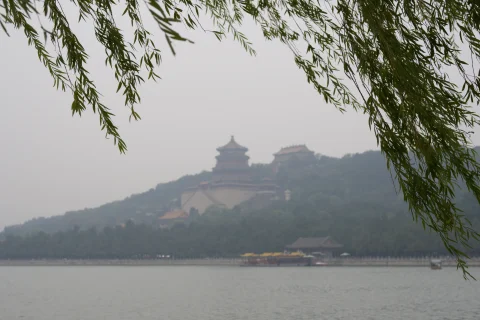
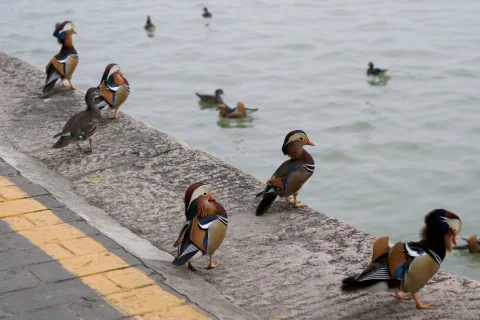
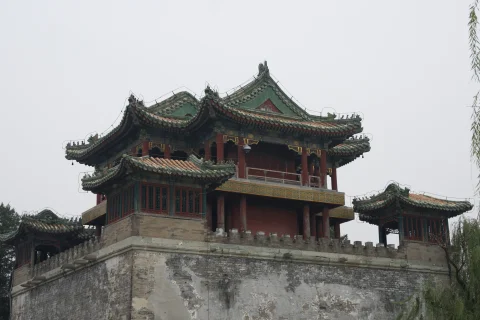
Traffic had left us with a choice: the planned buffet lunch or the Summer Palace, an imperial garden first laid out in 1750. We chose the palace and ate McDonald’s on the bus instead. A good trade. We walked beside the lake, past elegant buildings and trees, looking out through the haze. There were beautiful mandarin ducks. Once again, I had to admit the emperors knew how to live.
By the time we reached the station, I was in a terrible mood. We had been getting about six hours of sleep a night, and crowds drain my energy much faster than walking does. Add several hours without coffee and I become what I can only describe as an irritable, venomous little rat. Lena put up with me, encouraged me, and even went looking for coffee with me. She deserved a much better travelling companion that afternoon.
On the high-speed train to Xi’an, we could finally sit down. We watched Ted Lasso on an iPad set up between two rows of seats, with one wireless earbud each and a beer. A ridiculous arrangement, but a lovely way to end the day. By the time we reached our hotel in Xi’an, it was after midnight. We went straight to bed.
Xi’an: An Emperor’s Army and the Little Pumpkin Bracelet
The next morning, Xi’an’s broad, tree-lined streets looked greener still than Beijing’s. I wanted to get out of the bus and explore.
It was also the second anniversary of the day Lena and I met.
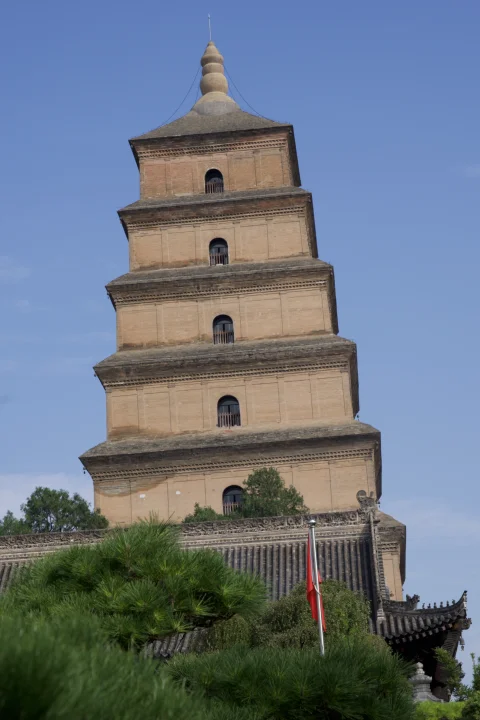
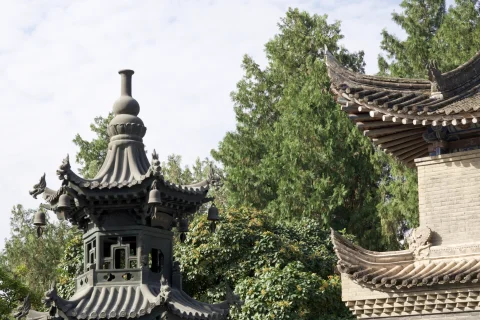
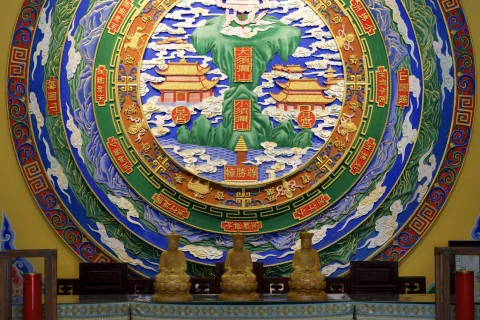
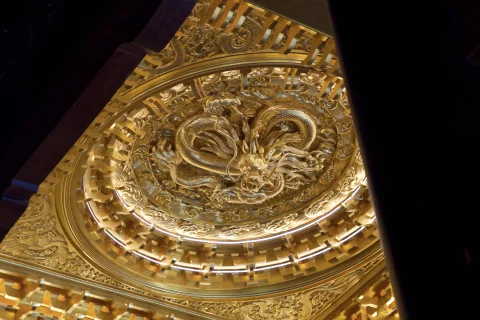
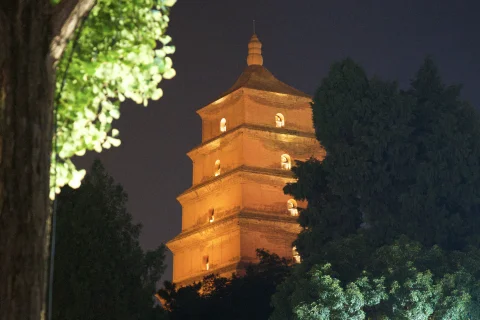
Our first stop was the park around the Giant Wild Goose Pagoda, first built in 652 during the Tang dynasty. The pagoda looked strikingly solid after the delicate roofs of Beijing. I liked the gardens even more: plants, inscriptions and little messages to stop and read, and enough peace and quiet to enjoy them.
We picked little Buddhist bookmarks with messages on them and discovered that we had drawn the same one. I hoped this was a lovely coincidence, rather than evidence that every bookmark in the basket said the same thing. Then Lena bought a mystery box containing a beaded bracelet. The colours turned out to match her other bracelets almost perfectly. Better still, it had a tiny pumpkin charm. I often call Lena my little pumpkin. On our anniversary, of all days. Twelve out of ten.
At the terracotta workshop, we listened to a short explanation of how the souvenir figures were made, then were led into an enormous shop. I had already had enough of these educational shopping visits, but this one contained a teapot.
I had wanted a porcelain teapot for some time, although I preferred the look of the clay ones I already owned to typical glossy porcelain. This one was porcelain made to look like clay, in a handsome little travel case. I loved it immediately.
We were supposedly getting a thirty-percent group discount. Lena tried to negotiate an even better price through our guide, who asked once and then lost interest in translating her increasingly inventive arguments. I was no help at all. I stood beside the teapot like a puppy watching someone take away a particularly delicious bone. My face was not helping the negotiations.
We bought it for 550 yuan, remember this number.
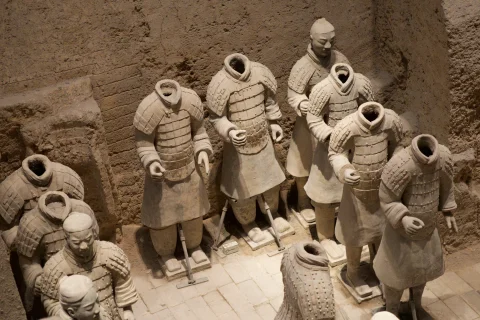
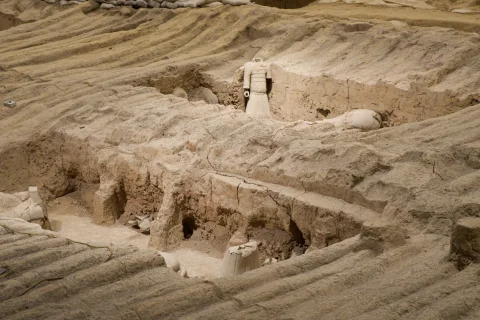
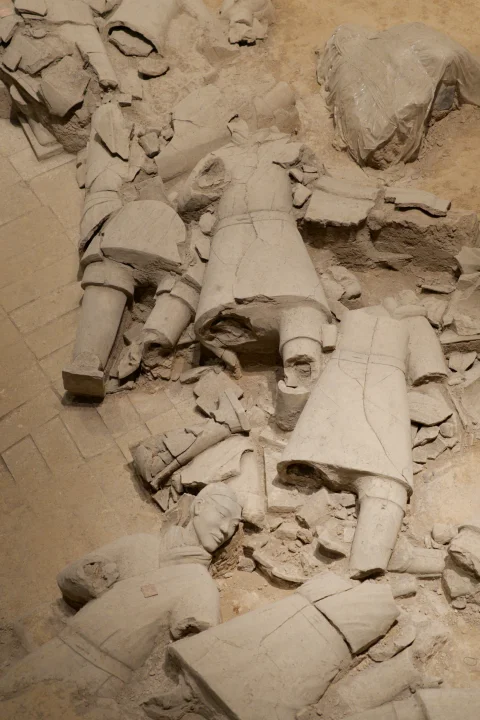
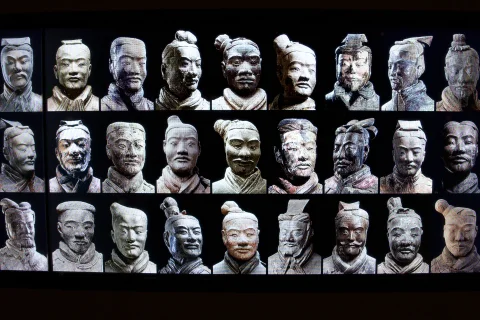
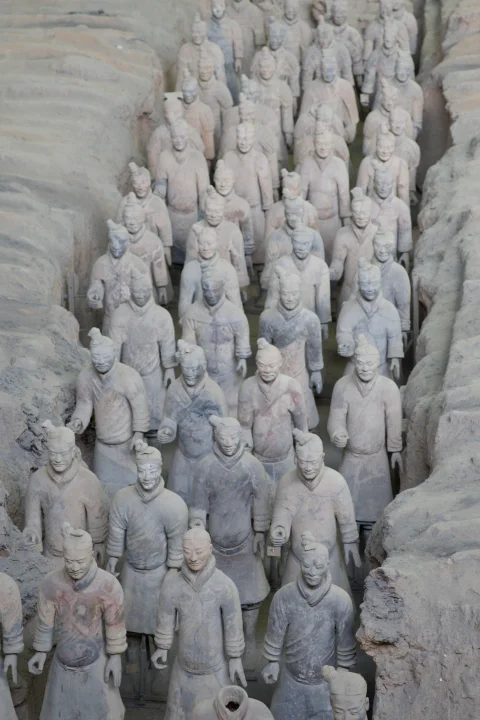
From the souvenir figures we moved on to the Terracotta Army, made for Qin Shi Huang, who unified China in 221 BCE and died in 210 BCE. The halls housing the excavations were enormous, but what held my attention was seeing the work at different stages. In one area, soldiers stood in formation. Elsewhere, fragments of bodies, horses and equipment emerged from the earth, alongside traces of the structures that had covered them. Archaeologists were still working below us. It felt like watching a past world being recovered, rather than looking at a finished reconstruction.
They also sold ice cream shaped like terracotta warriors. I bought one and offered Lena another. She declined. About five minutes later, I looked at her and could tell that the refusal had been a serious error. I sprinted back to the entrance kiosk and returned with a second soldier. It may have been the fastest I moved all afternoon.
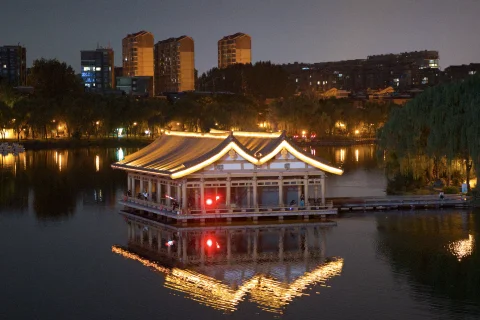
We were leaving Xi’an the next day, so that evening we went out to see it after dark. We stopped on a bridge to watch a dragon-shaped boat pass along the river. Later, near the pagoda, we stood with our arms around each other watching the illuminated fountains. We had not planned anything particularly romantic for our anniversary, but this would do very well.
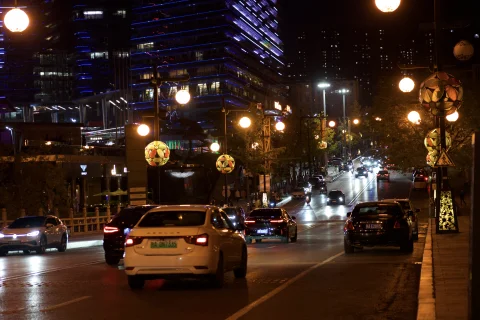
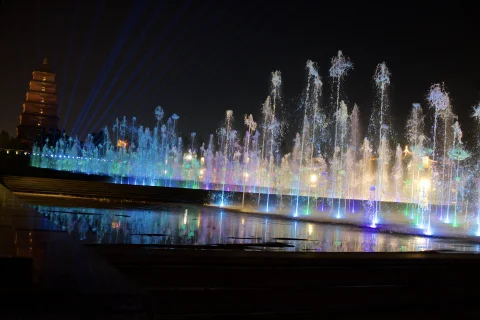
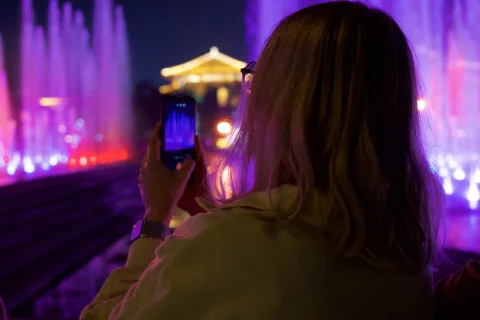
We carried on through streets that had come alive after dark, full of people walking, shopping and eating. We bought candied fruit and a meat-filled flatbread, roujiamo. The chopped pork unexpectedly reminded me of ropa vieja, my favourite food discovery in Cuba. Apparently, two very different countries had found the same way to make me happy: shredded meat in bread.
We finished the evening keeping an eye on the beverage market. The bar was a beer stock exchange: screens above a circular counter showed prices rising and falling with demand. You could choose a beer at the current rate and pour it yourself. I’m an investor of a kind.
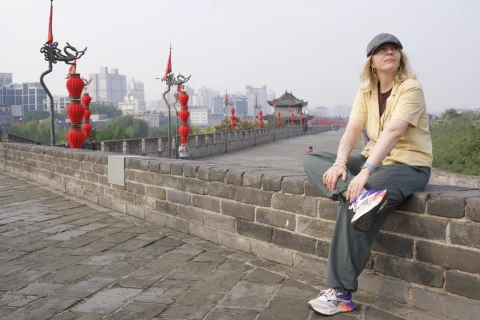
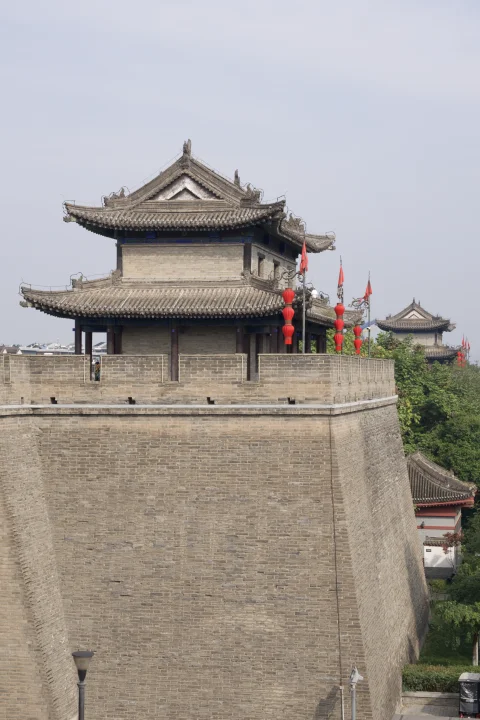
The next morning we visited the old city wall. I was expecting very little. From outside, the entrance looked like a fortress with a few cafés attached. Then we climbed up.
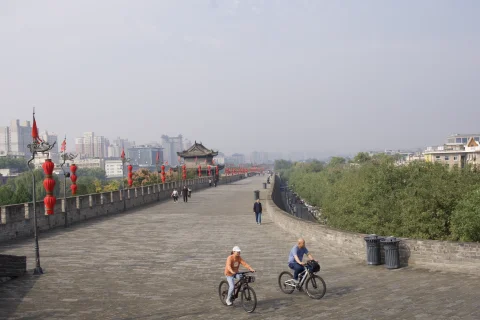
The top was immense. I had expected a wall; this was more like a road built above the city, stretching far into the distance. The full circuit is almost fourteen kilometres long. The fortifications date from the 1370s, under the Ming dynasty. There were gardens and streets on either side, bicycles for rent, and almost nobody in our way.
Here was the sense of scale I had expected from the Great Wall. I could walk, take photographs and look around without fighting my way through a crowd. The city wall impressed me more than the famous one in the mountains. But we had only half an hour.
Up there, I wanted to stay in Xi’an for a couple of weeks. I could rent a bicycle, explore the wall properly, then get to know the streets below: find places to eat, walk without an itinerary, and see what an ordinary day in the city felt like.
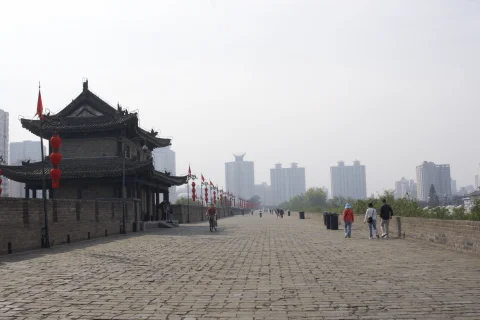
The map is centred on the South Gate as a reference for the wall circuit.
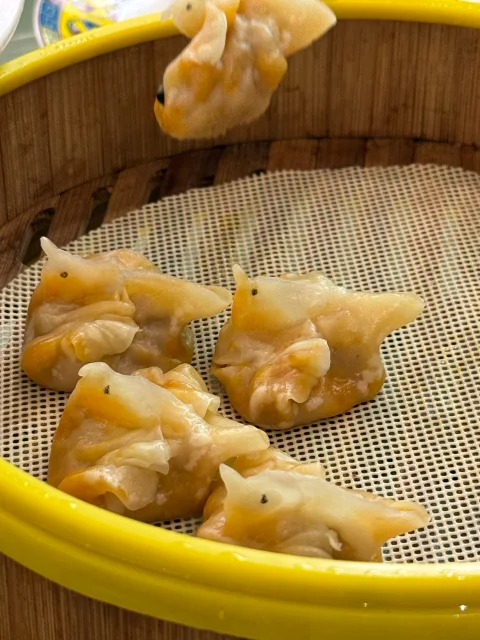
We had a dumpling banquet to get to, though. It offered little edible sculptures: duck dumplings shaped like ducks, and so on. They were beautiful to look at and considerably less rewarding to eat. The dough was dry, the fillings were dry. I am used to Russian pelmeni, which ought to have some juice inside. The best were the plain dumplings, which we could order as often as we liked. They comfortably beat the sculptures; a packet of pelmeni from a Moscow supermarket would have beaten them a hundred times over. I left convinced that we might have something to teach the Chinese about dumplings. This was, admittedly, based on one rather unfortunate banquet.
Getting from Xi’an to Zhangjiajie meant a flight to Changsha, then a train and a bus. At security in Xi’an, they wouldn’t let my favourite Anker power bank through because it didn’t have the Chinese CCC mark. Its international markings didn’t help. The choice was to leave it behind or miss the flight, so I handed it over. I was furious. For a moment I pictured myself saying exactly what I thought, getting detained, and spending the rest of the holiday in a Chinese cell while Lena brought me noodles. Fortunately, I kept quiet.
In protest, I pushed a security tray towards the edge of the counter, hoping somebody would knock it off. It did not fall. Lena later said I had behaved like a cat pushing something off a table. A fair assessment of my resistance.
We reached Zhangjiajie very late. The day had begun on one of the trip’s most impressive structures and ended with me mourning a battery.
Zhangjiajie: The Forest Below the Clouds
Rain hammered down overnight, and the forecast promised days of thunderstorms. We’d come mainly for the mountains associated with Avatar. I knew how easily wind and rain could shut cable cars down altogether. Travelling halfway across the continent to admire a ticket office was not the mountain holiday I had in mind.
My own waterproof jacket stopped at the waist, leaving my shorts entirely unprotected. At the hotel shop we bought enormous plastic raincoats and rubber overshoes. The overshoes would stay with us for days.
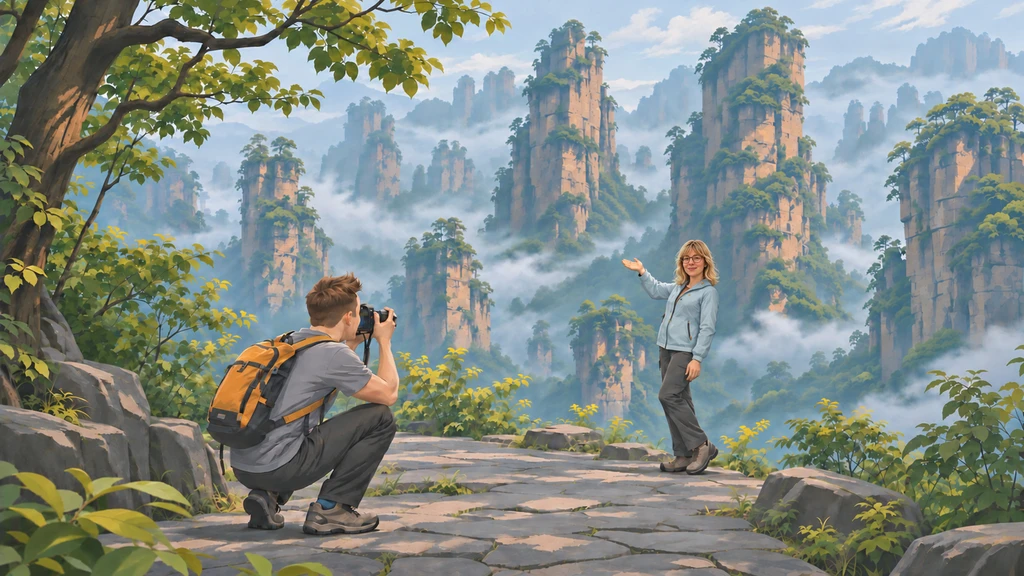
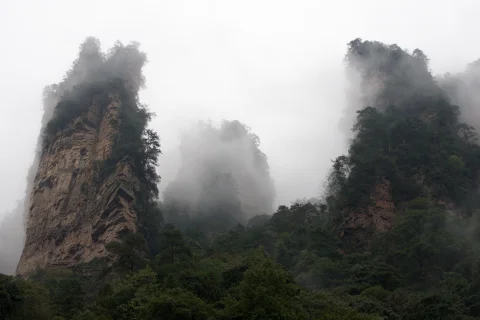
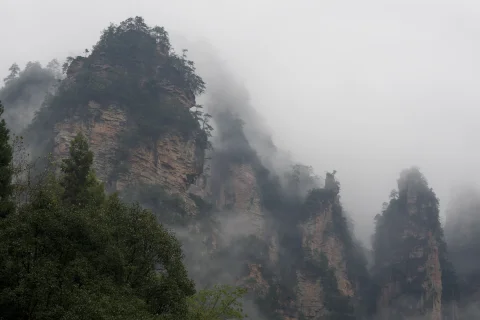
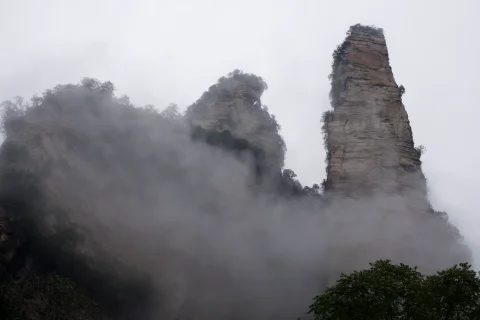
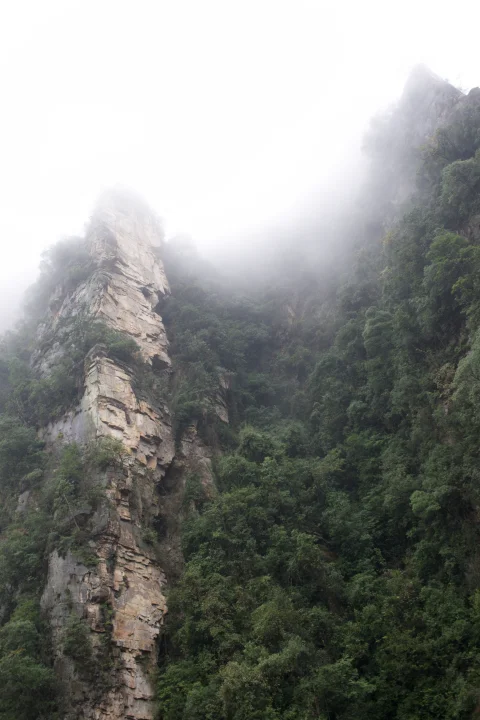
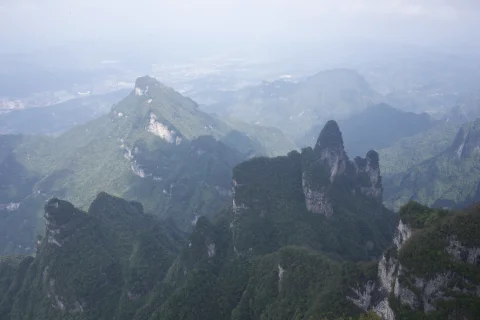
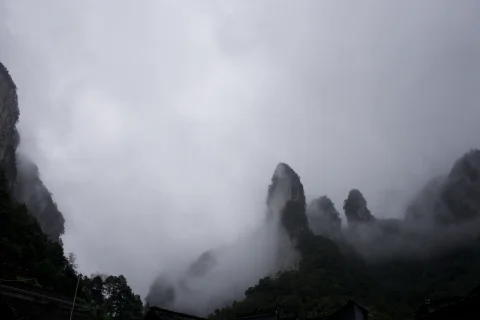
Approaching the park, we saw stone columns rising from green slopes into low cloud. For a while the rain eased. The formations looked too narrow and too tall to remain standing. It was magnificent. We kept turning in every direction, taking photographs of each other beneath the mountains. Whatever happened to the weather next, the trip had already been a success.
Overview of the scenic area; individual viewpoints and trail positions are not marked.
Then the rain came back with enthusiasm. We took a cable car to a viewpoint and discovered a perfectly unobstructed view of fog. Not even a hint of a mountain. We’d try the higher viewpoints the next day.
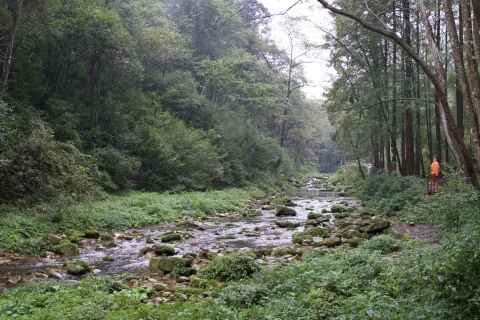
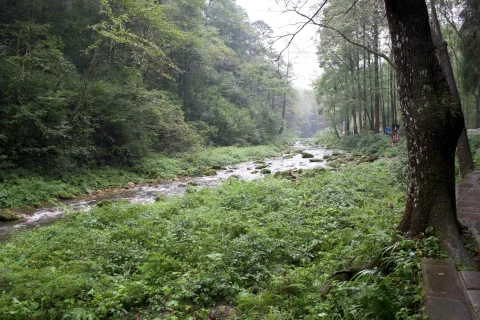
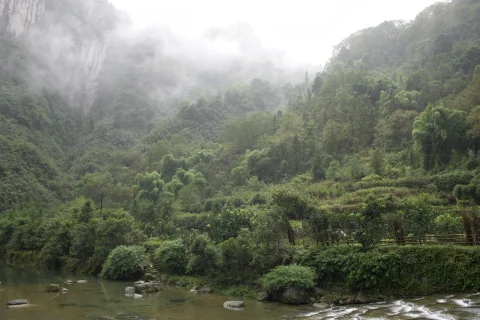
Instead we followed Golden Whip Stream into forest that felt ancient and rather otherworldly. Cliffs rose on either side, trees crowded the path, and I half expected a forest spirit to appear between the trunks. It reminded me less of Avatar than of Miyazaki’s Princess Mononoke. I had come to China and somehow wandered into a Japanese film.
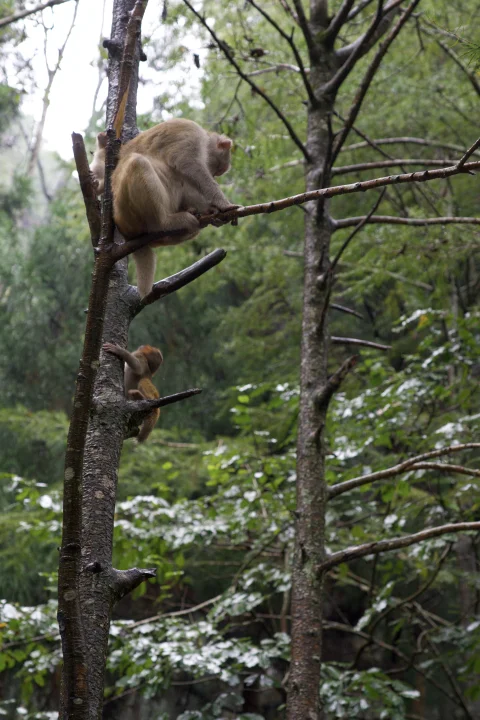
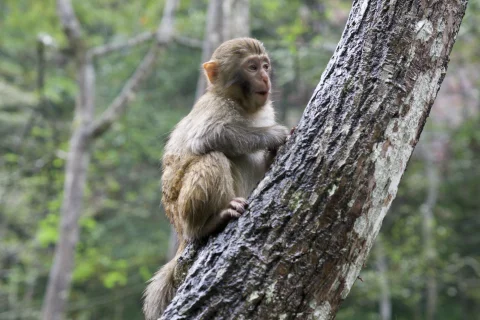
Monkeys leapt through the branches and wandered among visitors with the confidence of creatures that actually live there. We only walked part of the trail. At every bend, I wanted to see what came next.
With the higher viewpoints off the programme for now, our guide Katya took us to Yellow Dragon Cave. The narrow, crowded entrance didn’t give much of a hint of what was inside. Then we reached the larger chambers: illuminated rock formations, stairways climbing between levels, a spot where people shouted to hear the echo, and elaborate dragon decorations among the rocks. The place was vast. I was very happy to be spending a rainy afternoon down there.
A motorboat carried us along an underground river, past illuminated rock. Outside, near a waterfall, Katya showed us a giant salamander she said was 130 years old. It barely moved. Visitors had thrown coins onto its back. I struggled to imagine spending 130 years in what looked like an ornamental pool, though the salamander seemed at peace with the arrangement.
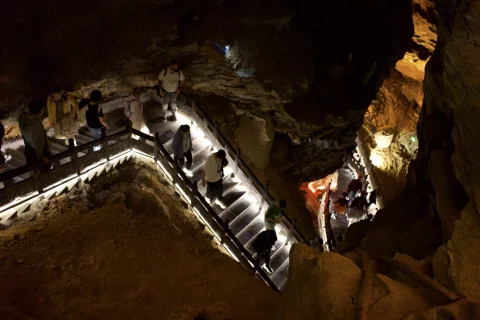
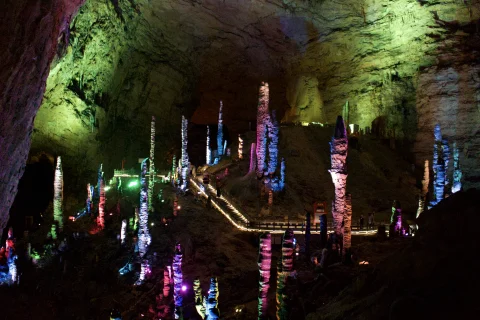
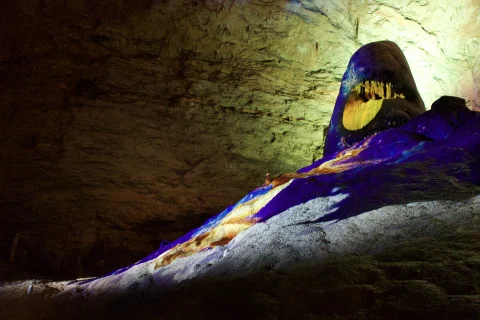
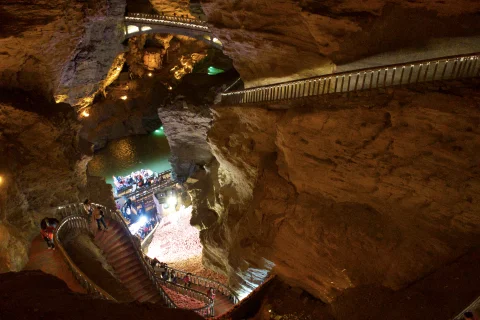
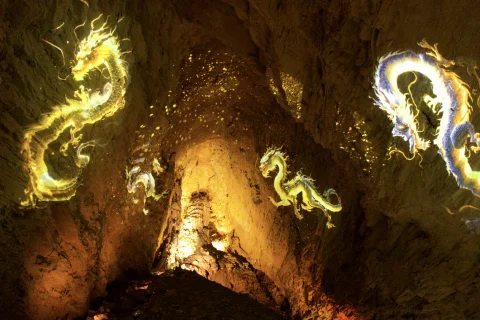
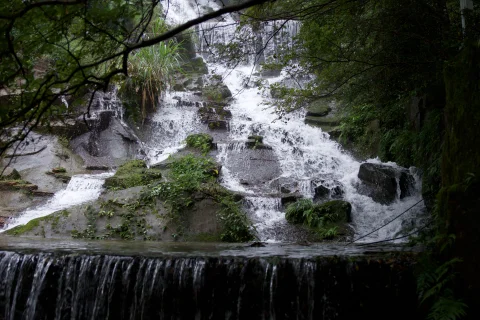
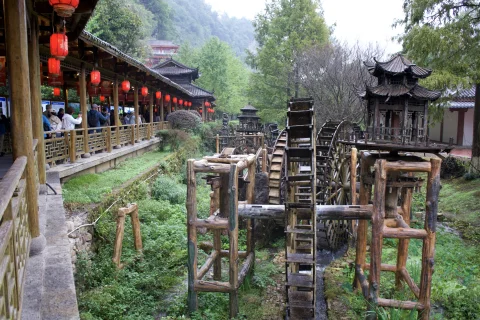
The cave entrance is marked; the photographs include the surrounding grounds.
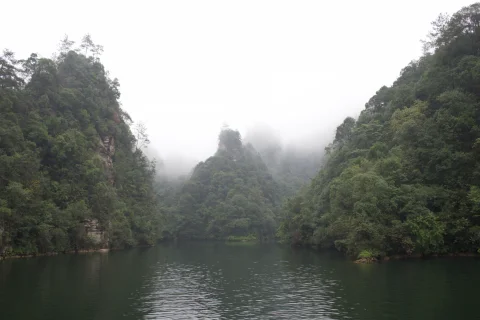
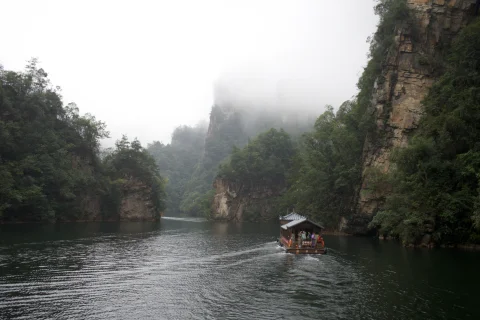
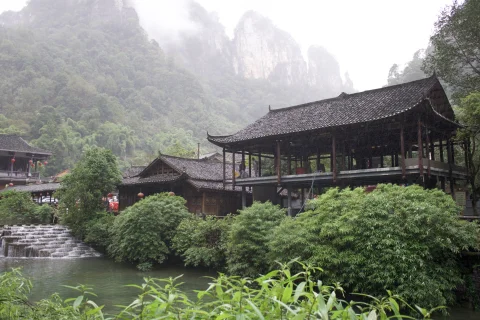
Our last outing was a boat ride on Baofeng Lake, and it was my favourite part of the day. By pure luck, our group got a boat with an upper deck, where we could look out over the water and take photographs. Green mountains rose around the lake, with other boats moving between them. Singers greeted us with traditional songs as we passed. It was a little cold up there, but I wouldn’t have traded that view for a warmer seat downstairs.
Back at the hotel, the final attraction was the laundry room. Our building’s washing machine was already in use, so we found one in another building, loaded it and went to dinner. We came back to find our clothes still unwashed and the machine switched off. We restarted it. Twenty minutes later, it stopped at almost the same point.
Groups of young people kept squeezing into the tiny laundry room. My working theory was that they were pressing the buttons with their backsides. I had no evidence, but the scientific method would have to wait until I had dry socks. Eventually we managed to finish a wash and get the clothes into a dryer. Three hours later they were still wet. I gave them another hour and a half, then we took them back to our room and hung them wherever they would fit.
Some of our clothes were still damp the next day. The laundry had become an ongoing project.
Zhangjiajie: Fog and the Teapot Index
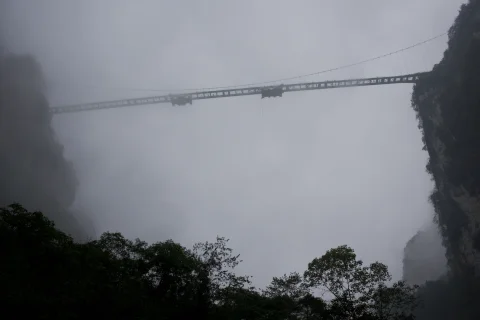
The next morning was wetter still. We began at the glass bridge over Zhangjiajie Grand Canyon. Taking that first step onto a glass panel was a bit scary. A few steps later it was just a floor, and I was taking photographs.
Our ticket covered only the bridge, but we could pay extra to continue down through the canyon. We decided to take the longer route.
The longer route included a zipline, which I skipped. Heights bother me less than having no control: on a motorcycle or behind the wheel, I can steer and brake. Hanging from a cable, my only job would be to wait for it to end. Lena persuaded me to try the slide instead. I barely moved and had to push myself along with my hands. Halfway down, a sign warned me to slow down before a sharp turn. I was still trying to gather enough speed to reach it.
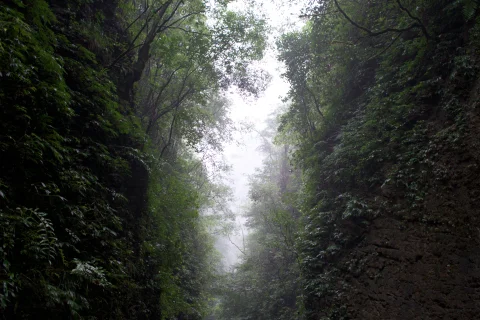
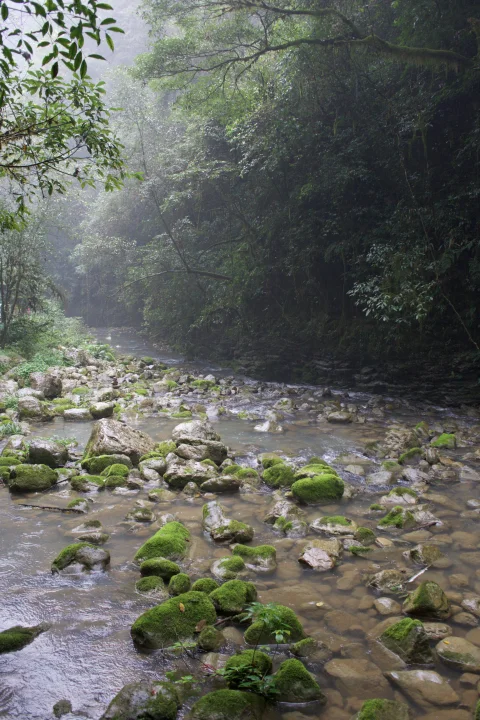
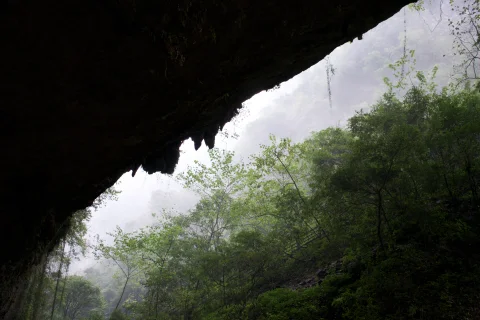
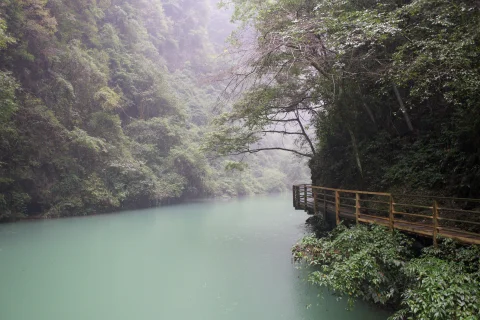
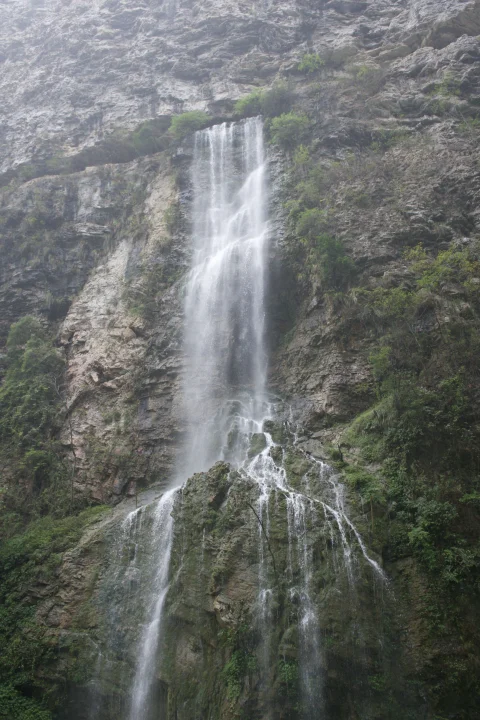
After a boat ride, we walked along the canyon floor. Rain fell almost continuously, and steep cliffs hung over us. Everything was dark and wet, but down here the weather seemed right for the place. I was glad we had continued beyond the bridge.
The glass bridge is marked as a reference for the surrounding canyon.
At the exit, something in a souvenir stall looked familiar. A teapot. The same shape, the same colour, the same handsome travel case. The price was 150 yuan. We had paid 550 in Xi’an after our generous discount. We went back for another look. The seller offered it for 100.
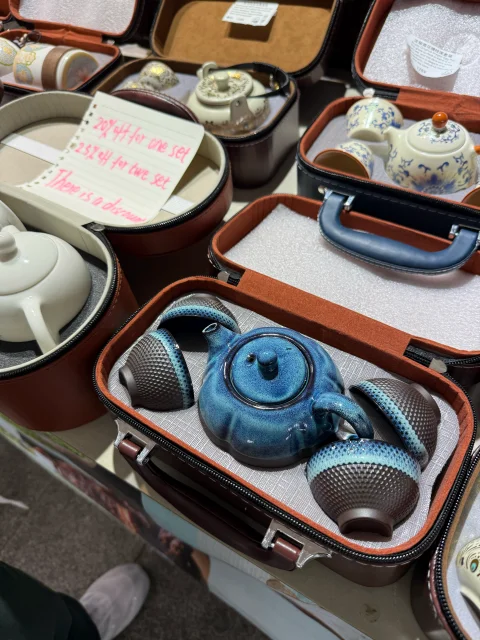
Worse, the evening before I had tried making tea in mine: its water seal did not work at all. A sensible person might learn about teapots before starting a collection. I had chosen the opposite order. Why take the easy route?
For the rest of the trip we had our own informal measure of tourist-shop prices: the Teapot Index. Unfortunately, it kept producing interesting results.
We went back to try the mountain viewpoints we’d put off the day before. Katya cheerfully explained that reaching them involved a cable car and six more local buses. The lower slopes were beautiful. As we climbed, they disappeared into fog.
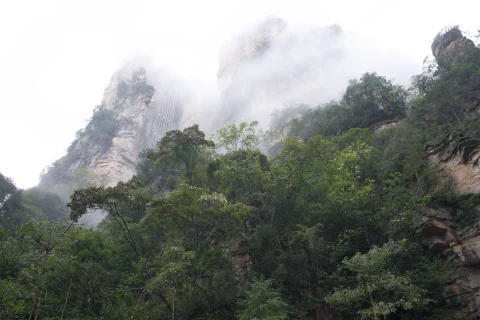
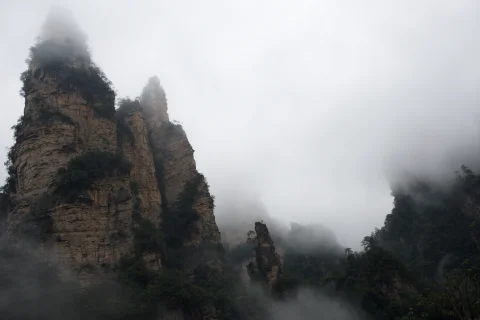
For hours we walked between famous viewpoints, reading signs about the rock formations we were supposed to be seeing. Here was an Avatar pillar; here was a celebrated view across the valley. In front of us: white. Not a particularly interesting white, either.
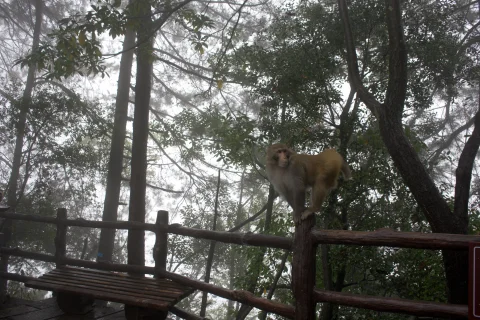
Monkeys appeared beside the paths. Lena was wary after her experiences with them in India. I was cautious too, especially when tourists approached a baby. Bothering their young seemed a reliable way to start an argument with the whole family.
We did reach the First Bridge Under Heaven, a natural sandstone bridge between two cliffs in the Yuanjiajie area. Even through the mist, what little we could see of it was fascinating. People had tied red ribbons with names and wishes along the route. Lena and I added ours.
By then, several short nights had caught up with us. The rubber overshoes kept our feet dry but squeezed our trainers. Then there were the enormous plastic raincoats.
We kept our bags under the raincoats; a dry person with a soaked backpack seemed only half a solution. Lena was tired of carrying hers, so I put it on my back and shifted my camera bag to the front. Getting the raincoat fastened around the whole contraption was a struggle.
Lena asked whether I was comfortable. I assured her that everything was perfectly fine. I sounded just as confident as I had in Vladivostok when I’d told her there were no snakes. The difference was that in Vladivostok I had no idea whether I was telling the truth. Here I knew perfectly well I was lying. I wanted to tear the raincoat off and drop every bag I was carrying. But Lena needed a break, so I kept going.
We finally returned to town, ate dinner and walked a little through the evening streets. We had bought some snacks and planned to make tea with our expensive teapot. I felt it ought to contribute something to the holiday, even if that contribution was merely an awkward cup of tea.
Tianmen Mountain and a Night in Fenghuang
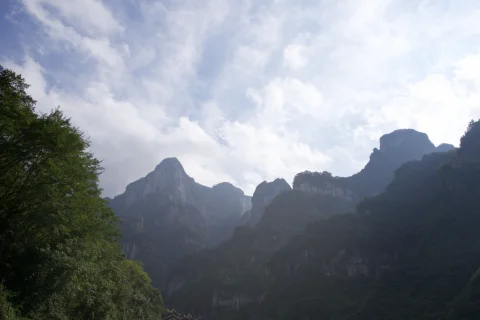
The next morning brought patches of blue sky, and the sun shone for most of the drive towards Tianmen Mountain. We started to believe that, at last, we might get a clear day in the mountains.
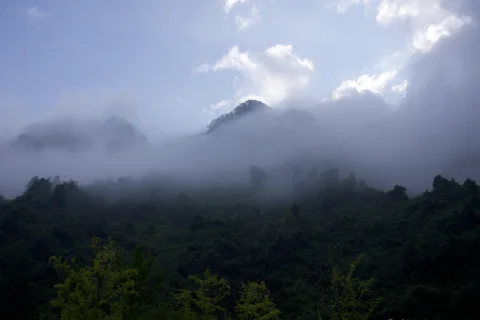
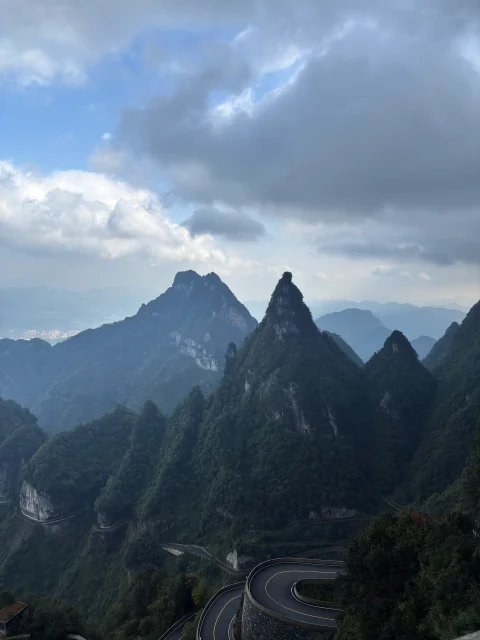
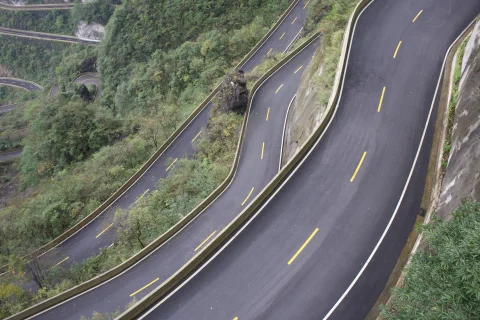
Overview of the mountain, its approach road and upper trails.
Just before the entrance, the bus drove into thicker fog than anything we had seen the day before. Our optimism did not survive the last turn.
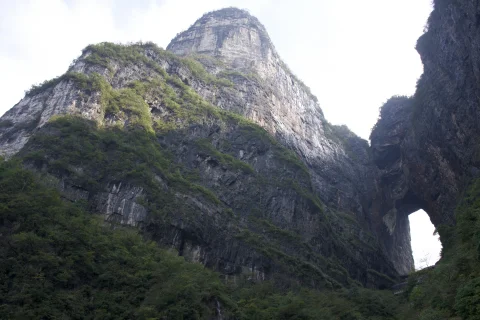
From the lower square we could make out Heaven’s Gate, the enormous opening in the mountain, and the staircase leading to it. We chose the stairs: all 999 of them. I climbed quickly; Lena took more breaks but kept going to the top. Given how tired we both were, I admired her determination. We took before-and-after photos; by the time we reached the top, we both had suitably red faces.
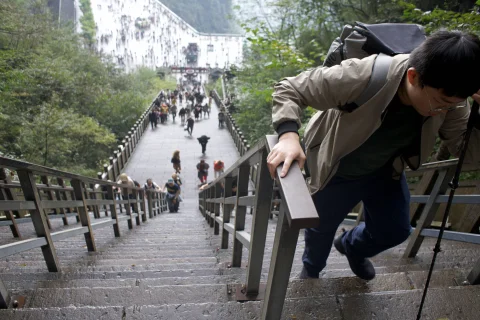
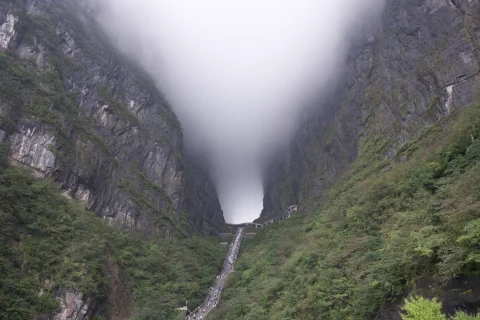
After the stairs came about seven escalators running through the mountain. One ended, you walked a few steps, another began. Only in China, I thought, could you go to see a mountain and discover that someone had equipped it with an entire escalator system. I tried to imagine the same thing in a European national park and failed.
On the upper trails, the fog shifted enough to give us glimpses of cliffs and valleys. We had a choice between an enclosed route up and a chairlift. I’d missed the word open and couldn’t understand what there was to discuss.
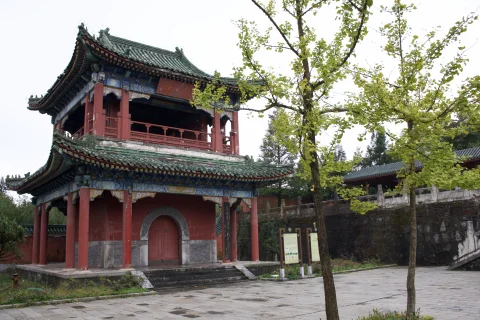
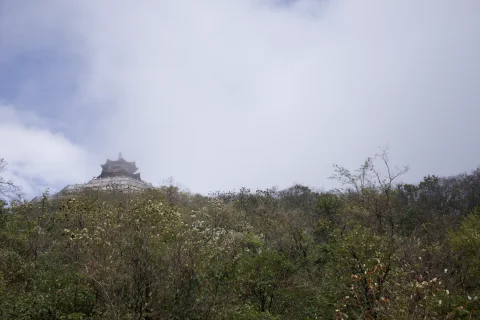
The answer became clear when we sat down. It was an open chairlift, like the ones at ski resorts, with no cabin around us. At first it was a little frightening, then rather enjoyable. Then we crossed a gap between two cliffs and it became frightening again. Below us there was almost nothing to focus on: no reassuring forest canopy, just space. My contribution to the operation was limited to sitting still. At the top, the wind was strong enough to make standing still feel like a small achievement.
On the way down, people on the opposite escalators began shouting cheerful hellos. I joined in, shouting “Ni hao!” and exchanging high-fives as we passed. Lena taught me the little finger-heart gesture she called a Korean heart. Much to my surprise, I was having an absurd amount of fun. Apparently my introversion made an exception for shouting hello to strangers on an escalator.
After the descent, a photo booth offered portraits with Heaven’s Gate in the background, printed as newspaper articles about visiting celebrities. It was ridiculous, and I thought it was a great idea. We had one made.
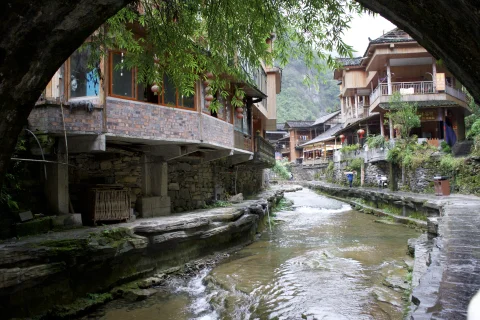
A long bus ride that evening took us to Fenghuang, the old river town whose name means Phoenix. Our hotel had seen better days, but we went out to see what was happening by the river.
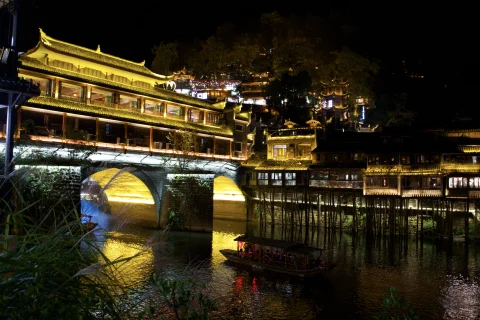
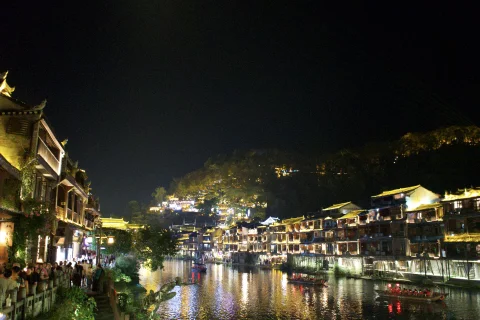
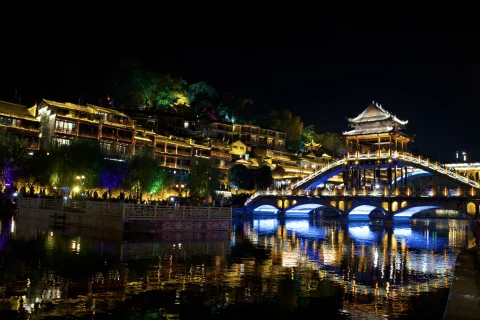
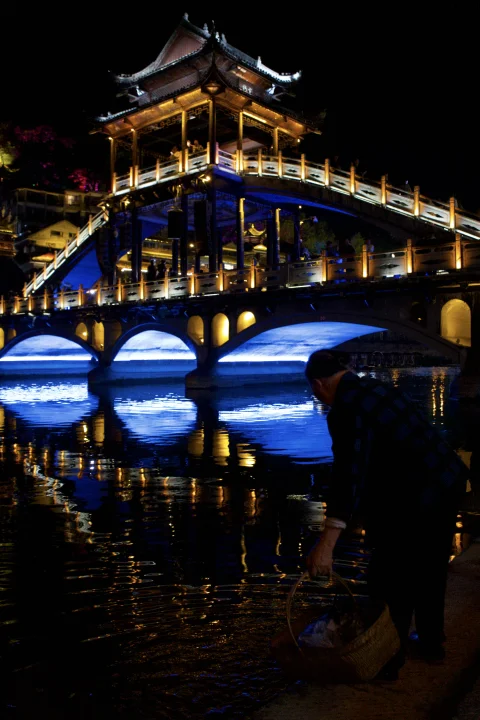
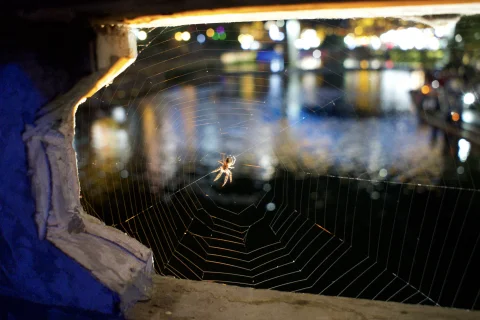
Fenghuang at night was all reflections and light. Buildings glowed above the river, shops were open, people filled the paths, and something like a magical castle stood on the hillside. On one bridge I eventually noticed that almost every section of railing had a large web with a large spider sitting in it. We had already been leaning all over those railings to take photographs. I checked whether I had developed any Spider-Man powers. Perhaps these spiders bite very gently; you never know.
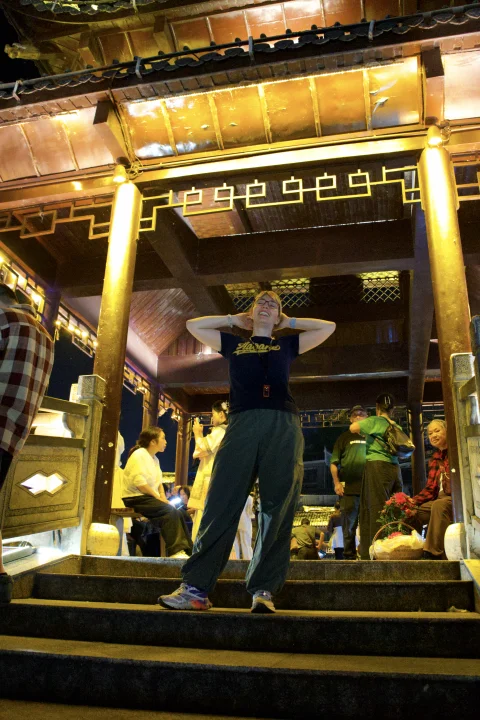
We escaped into a quiet lane, only to run into our group again at a tea shop. Fifteen visitors were trying to fit around a tasting counter built for perhaps three. We left them to it and carried on through the lanes.
We were heading back when Lena remembered a stall selling pearl mussels. She wanted to see how the pearls were taken out and turned into jewellery, and she was quite certain she knew where the stall was. She led the way, pointing out landmarks she recognised. I recognised none of them. In fact, I was fairly sure we had never been on those streets before.
She had somehow mixed up Fenghuang with the streets where we had bought snacks in Xi’an. I could see the next twenty minutes unfolding: more searching, growing annoyance, and eventually me buying her some sweet on a stick to restore morale. After two days of carrying bags around mountains, I had little energy left for a search.
So I made an offer: I would show her where I thought the stall was, and if I turned out to be wrong, I’d say, out loud, that I was wrong. She accepted at once. Apparently hearing me say those words is a rare and valuable prize.
Fortunately, I was right. We found the stall almost immediately.
There was a tub of pearl mussels in three sizes: small, medium and properly large. You bought one, the seller opened it, and you could help remove the pearls. Lena studied the choices and said she wanted a medium one. Her face told a different story. While she was looking away, I silently pointed out the largest one to the seller.
He opened the mussel, and Lena dug out the pearls herself. They were wet, slippery and rather strange to handle, but she loved the experience. They weren’t just white: their iridescent colours worked beautifully with her bracelets. The seller cleaned and drilled them, measured her wrist for the bracelet, then found two matching pearls and offered to make earrings as well. Naturally, I agreed. Lena squeaked with delight when she saw the finished jewellery.
It was a mystery box in its most literal form. Lena loves them because she doesn’t know what she’ll get; I usually dislike them for exactly the same reason. Here, though, I was very glad we had tried it. She’d helped make the souvenir herself, and she would have that evening to remember whenever she wore it.
A small crowd gathered to watch. I joked that we ought to get a discount for attracting customers, and then we actually asked. We managed to negotiate about three yuan off a bill of roughly two hundred. Not one of Lena’s more decisive victories, but better than nothing.
At the stall, we got talking to a couple from Los Angeles. I invited them to Moscow, and we joked that Lena and I were collecting communist countries: Cuba, China, perhaps North Korea next. Neither country was much like the place I’d pictured. The couple bought a pearl bracelet too. Perhaps we should have asked for more than three yuan.
We walked back to our shabby hotel with Lena’s new jewellery. After the weather and the long days in the mountains, it felt like a very good evening.
Fenghuang Before Coffee
In daylight, last night’s magical castle resembled a shed assembled from old timber. The lighting had been doing a lot of the work.
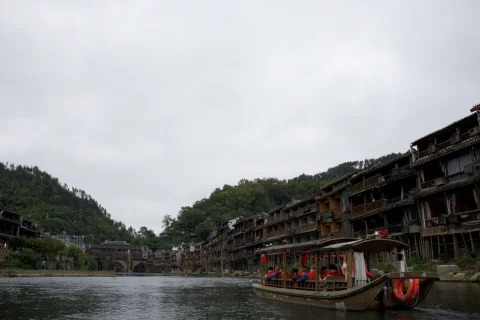
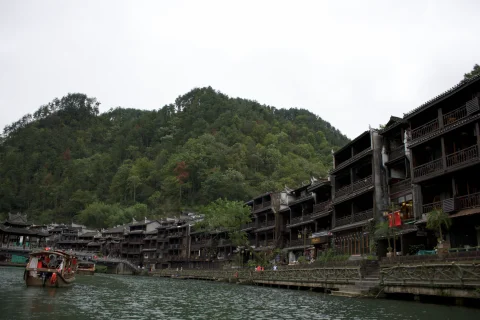
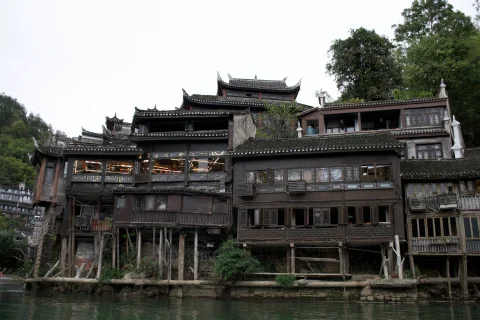
The hotel coffee machine was broken. Before we were due to leave, two fellow caffeine-deprived travellers and I announced an expedition to a nearby McDonald’s. The one employee on duty made our coffees at the pace of the sloth from Zootopia, though without the character’s warmth or good humour.
While we waited, messages started arriving from Lena. The bus was leaving. Where was I? Somebody had been sent to find us. We got our coffees and walked briskly back, trying not to spill them. Our rescuer had apparently made it about fifteen metres from the hotel before giving up the search. He waved at us to hurry up, which was difficult with full cups in our hands.
Back at the bus, he began lecturing me about how inconsiderate it had been to go for coffee. We had spent much of the trip waiting for a fellow traveller who repeatedly wandered off, so I was surprised to discover that punctuality had joined the tour only that morning. I said as much. Then I drank my coffee, and my mood improved almost immediately.
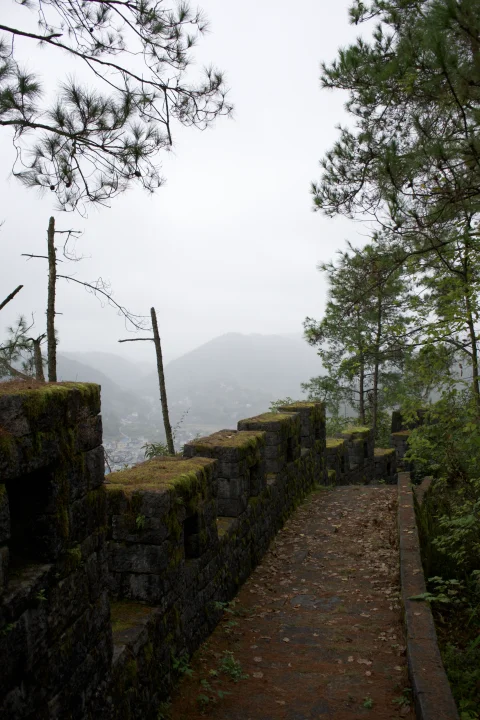
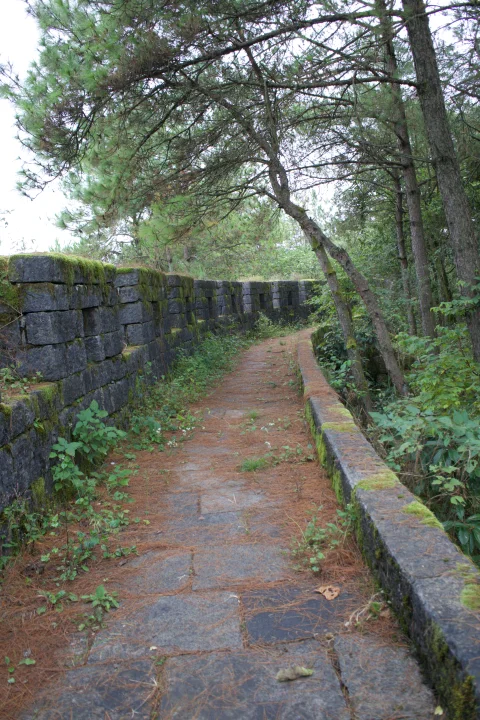
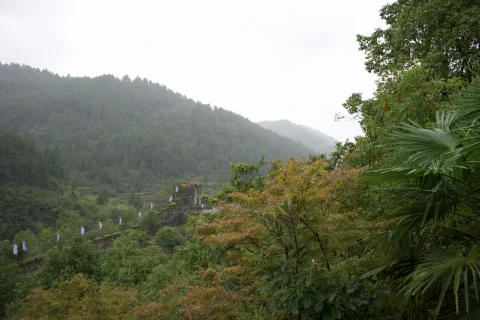
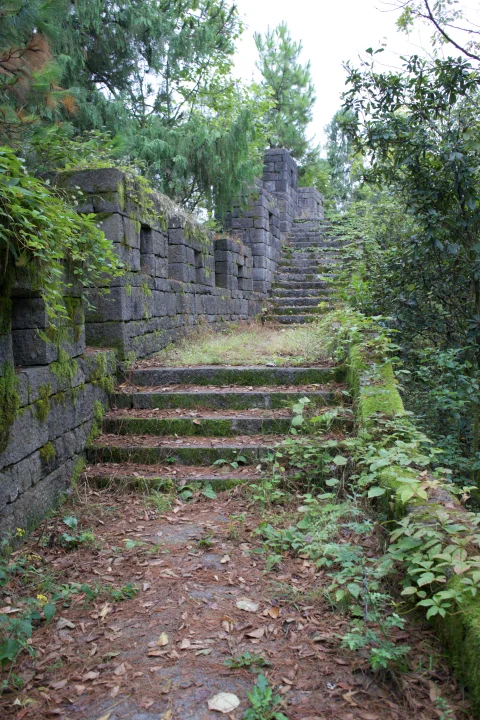
Lena stayed below while I climbed to the hilltop fort on the Southern Great Wall, built in the 1500s and 1600s to control the Miao region. The Miao are one of China’s ethnic minorities. There were old walls and weathered stones among the trees; it felt like a ruin rather than a reconstruction. A bit of morning cardio and some old walls to explore suited me perfectly.
The toilet had waist-high partitions, making privacy more of a suggestion than a design requirement. A man squatting in one of the cubicles told me sadly that he’d been there for ten minutes. I wished him luck and resisted the urge to let out an eagle screech. The fact that I wanted to do it at all probably says nothing good about me.
After the old walls, the Miao village felt very carefully arranged for visitors. There were staged performances and songs through loudspeakers, but I couldn’t get much sense of life there beyond the tourist show. I enjoyed the beautiful surrounding landscape much more. The coffee was excellent too.
We were sorry to say goodbye to Katya. Throughout our time in Zhangjiajie and Fenghuang she had kept finding local things for us to try, sometimes buying snacks or flatbreads herself and passing them around. She seemed pleased to show us her region. We hugged her goodbye. I could not imagine doing that with every guide we had met on the tour.
On the way to the airport, even the bus decided it had done enough touring. The driver stopped abruptly and rushed outside. We waited about an hour for a replacement bus.
At the airport, I inspected another addition to our collection of business lounges. This one was smaller than our previous hotel room, with almost nothing to eat except sweets and some peculiar camel-milk biscuits. Such was the World of Luxury and Comfort.
After the flight, our habitual wanderer disappeared again. Aviation had successfully delivered twenty-seven people to Shanghai; getting them all out of the airport was proving more ambitious. Finding him took what felt like forty minutes. We finally reached the hotel at around three in the morning.
Somebody suggested an optional excursion at seven. Four hours later. We declined. I am still amazed that the idea was seriously proposed.
Shanghai: A Day of Our Own
We began our first free day in Shanghai short of sleep and with aching stomachs. Breakfast was an effort. We were in no condition for shopping.
Shopping was, however, precisely what we intended to do.
On Nanjing Road, Lena had one objective: the latest, shiniest Dyson hair styler. Her spirit animal is a magpie; anything shiny stands a good chance of coming home with us. The finer points of styling are lost on me, but I understood that this was an important day for hair. First we needed to change money.
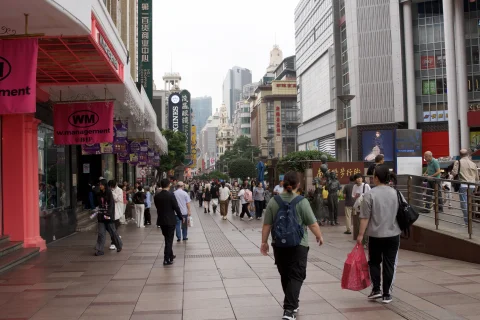
The currency exchange counter was on basement level B2. We were already struggling with B1. The lifts seemed determined to go no lower than the ground floor, and the woman at the information desk soon knew us better than we knew the building. Each time we returned, she pointed towards the same escalator a little less enthusiastically. Eventually we found B1, searched it thoroughly and went back to report that there was no exchange counter. Her answer remained B2. The breakthrough came when we noticed the next escalator about a metre from where we had been standing. We had crossed China and been defeated by the next floor.
Once we’d changed our money, we stopped for coffee. Before our drinks arrived, the staff brought complimentary snacks and small cups of tea. I ordered a Hokkaido sea-salt latte. The words sea salt might reasonably have suggested that the drink would be salty. I had somehow overlooked this detail. Coffee, milk and salt turned out to be one of the least enjoyable combinations I have ever paid to drink.
Back at the Dyson shop, we finally bought the hair styler. Lena wanted to be sure the colour was right, everything was included and the tax refund paperwork was correct. We checked it all, and she was happy. I, too, was delighted: I now had the honour of carrying this brick around for the rest of the day.
During the day, Lena tripped over steps three times in almost exactly the same way, usually immediately after letting go of my hand. I helped her, then somehow the same sequence would happen again. It was the way it kept happening, almost on cue, that made me laugh. I compared her to a dodo and asked how she had survived in the wild before we met.
My objections to mystery boxes lasted until we found a shop full of pigs in costumes. I have a weakness for pigs. Perhaps I feel some kinship with them. I bought a blind box from the LuLu the Piggy horror series, hoping for the werewolf. Naturally, I got the ghost bride in a red wedding outfit. She was still adorable.
Even the ice creams came as ridiculous little dogs and cats. Lena and I have a tradition of sending each other little video messages of “ridiculous dogs”: the smaller, sillier and more absurd, the better. She bought me one with the words, “This is for my Masik.” We also had a jar of M&M’s printed with a terrible selfie of us. Printing made it look even worse. We considered this an improvement.
Lena wasn’t the only one who could lose herself in a shop. The Lego store was enormous, with a huge dragon inside. I wandered around staring at sets I wanted. If you looked closely, you could probably trace my route by the little trail of drool, like a giant snail. I try not to buy too much Lego because I have nowhere to put it. One of my ambitions is to own a hangar full of assembled sets. For now we settled on a small flying Ford Anglia from Harry Potter, which would fit at home.
And then we entered Uniqlo.
The next three hours are a bit of a blur. Uniqlo is one of the few brands whose clothes consistently fit both of us well, so we go whenever we get the chance. For us, it’s a kind of Disneyland where everything comes in several colours and we can actually wear the souvenirs. During the tax-free paperwork, the printer naturally chose our form to jam on. Eventually we got it sorted and emerged with a mountain of clothes.
We dragged our bags back to the hotel, then went looking for dinner. My little toad-shaped AI companion, Zhabye, had suggested a Chinese restaurant. Its name was written entirely in Chinese characters. We walked around comparing shop signs with the characters on our phones, which is a miserable way to find a restaurant. Eventually I thought to search for a photograph of the entrance. That worked. We found the place, decided it didn’t look particularly inviting, and went to the Japanese restaurant opposite.
The ramen was fantastic, with meat, a lovely soft egg and a broth we both loved. Lena immediately ranked it second on her list of favourite foods, behind borscht and ahead of kokorki, a speciality from Tver made with potatoes and bacon. Knocking kokorki down a place is no small achievement. We walked back to the hotel very tired and very content.
Shanghai: The Guided Tour That Lost Its Tourists
We’d deliberately saved most of Shanghai’s sights for the guided tour the next day. No point visiting everything twice, we thought. A local guide would show us around and explain what we were seeing.
The tour began with broken audio receivers, a guide who kept talking anyway, and a driver doubling as tech support. The commentary went something like this: “On your left is a wall. Look up and you can see a roof. A roof is very useful when it rains. On the right there is a pond. It contains water. And ahead is an iron bridge. Sorry, a stone bridge.”
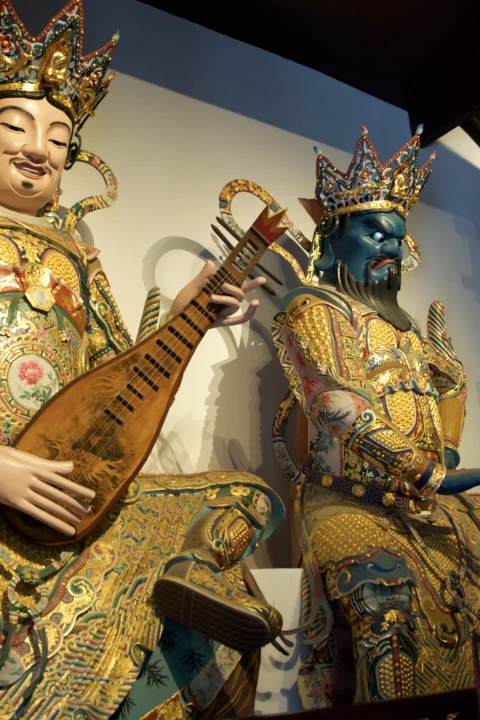
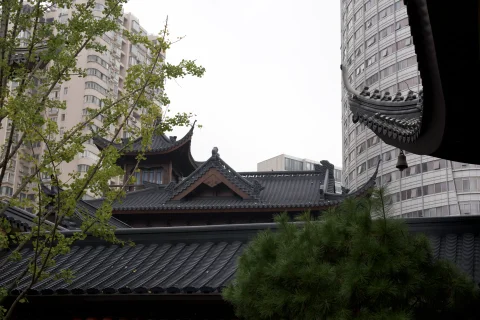
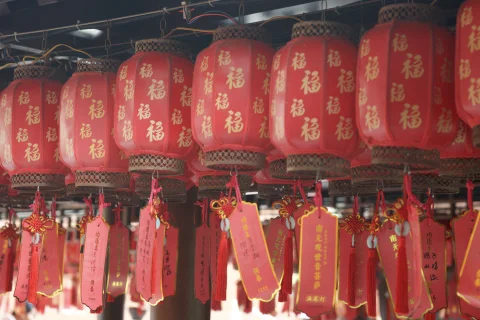
Inside the crowded Jade Buddha Temple, founded in 1882, hall after hall of Buddha figures failed to hold my attention.
Around the Oriental Pearl Tower, I perked up. Skyscrapers and elevated walkways made me want to explore, find some good angles for photos and see where the paths led.
We were given ten minutes.
Most of those ten minutes went on a toilet stop and coffee. I managed a few photographs of the tower on the run. Lena took a picture of me hanging from a railing with one hand, contorting myself to get the angle I wanted. I am aware that this is not entirely normal behaviour. I hope the photograph was worth it.
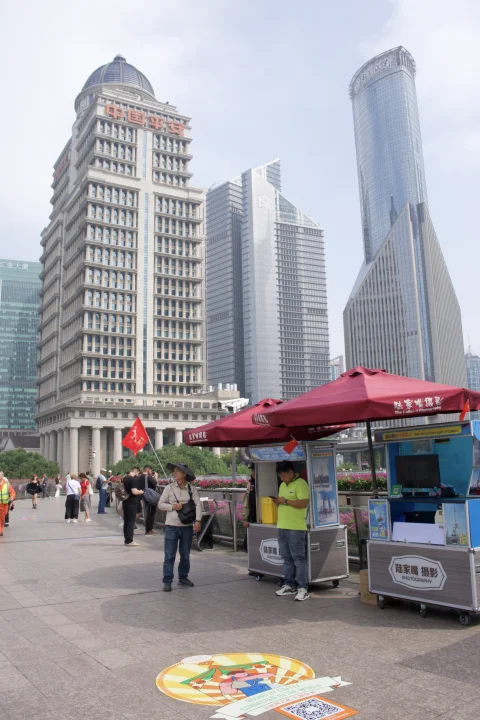
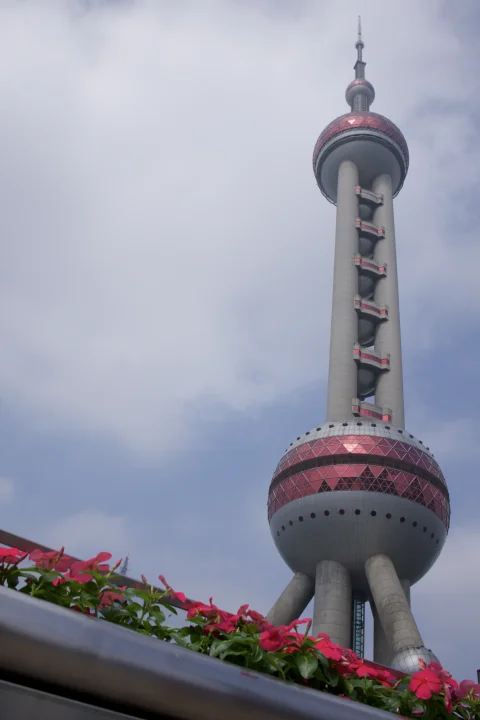
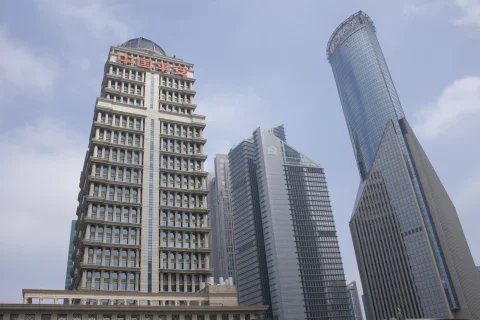
Then our guide announced lunch. It was barely noon; we had eaten breakfast at ten. After some discussion, she moved it to one. The schedule had acquired an hour of theoretical flexibility.
Before lunch, instead of the promised garden, our bus pulled into an underground car park. We were led into a hot, stuffy space with a souvenir shop, where we were expected to spend half an hour. This stop wasn’t on the itinerary we’d booked.
The Teapot Index confirmed that the souvenirs were expensive. Our guide had called this a good place for bargains. Ten minutes among the skyscrapers, thirty in a car park buying trinkets. Lena and I were furious.
This was what bothered me about the tour. I liked having a guide who could explain what we were seeing, but I also wanted some say in how we spent the day. In Cuba, our smaller group had agreed on changes together. Twenty-seven people were harder to organise, fair enough. But surely we could have skipped this shop.
After lunch we finally reached Yu Garden, begun in 1559 during the Ming dynasty. In a better mood, I might have appreciated the ponds and carefully arranged plants more. After the Summer Palace, I felt as if I had left the Moscow Botanical Garden to inspect Aunt Glasha’s parsley beds. Very nice parsley, I’m sure.
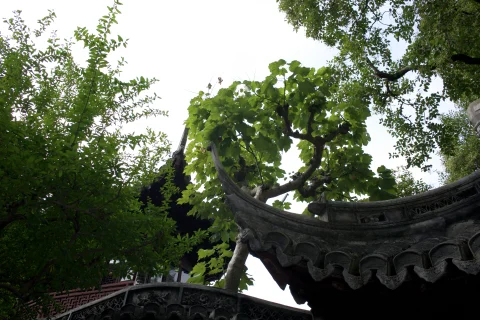
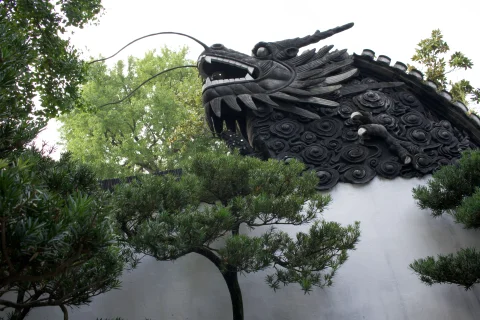
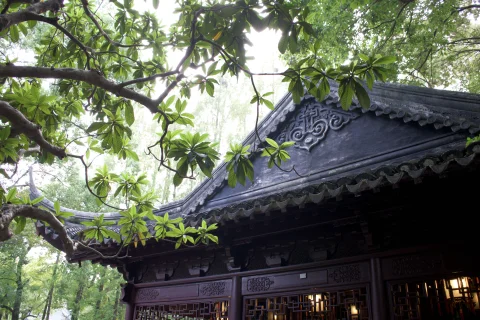
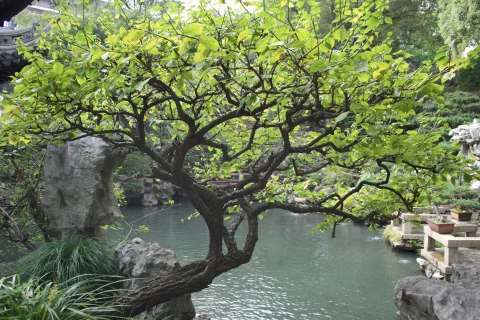
On the way out, our guide suggested a visit to yet another expensive tea shop. We left her to it and went for cold drinks.
At the Bund, members of the group began returning their audio receivers and announcing that they would explore on their own. One by one, they disappeared. We did the same.
We were planning a formal complaint about the detours and lack of useful commentary. Zhabye and Lena’s beetroot-shaped AI companion, Borshchevitsa, exchanged emails and compared our versions of events. A small law firm was forming: one amphibian partner, one root vegetable.
Free of the group, we walked along Nanjing Road. Lena spotted a shop she knew from Instagram, selling personalised cream based on the flower associated with your birthday. This was the girliest thing I could imagine. If I loved her any less, I would have gone off to bash nettles with a stick. She waited happily for her jar to be engraved. Naturally, I checked my birthday too. My flower was a mimosa.
A mimosa. In Russian, mimosa is also the name of a layered salad. I would have accepted a rose, a lily, perhaps something impressive or mysterious. Instead the botanical universe had assigned me a salad. I immediately lost interest in the shop.
Lena kept rushing into shops full of toys and odd little objects. The magpie was back on patrol. It reminded me of being a child, unable to pass a bright market stall. An entire shopping complex turned out to be devoted to anime: figures, themed shops, people who looked like anime schoolkids. I had hoped to find comics in English. I didn’t buy anything, but it was fun to look around. The toilets were excellent too.
We stopped to look at cars in a Huawei showroom and laughed at how brands I associate with consumer electronics now sell expensive vehicles. Xiaomi had made a similar impression on me. Apparently the companies selling phones and vacuum cleaners have decided that cars belong in the catalogue as well.
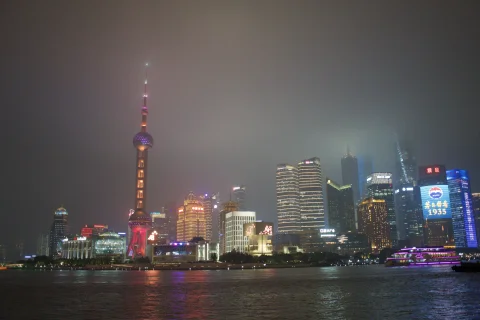
We returned to the Bund just as the lights came on for the evening. The towers across the river began to glow, and the whole place looked magnificent. That was the Shanghai I had wanted to see. We worked our way through the crowd to the railings and took a lot of photographs. Some of the pictures I took of Lena there are among my favourites from the trip.
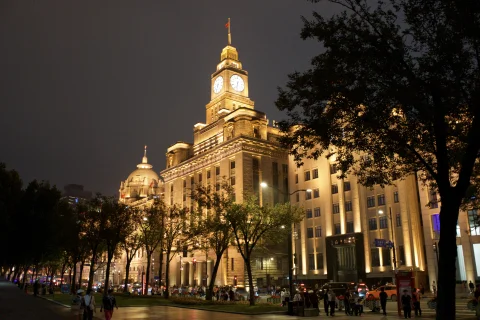
We went back to the Japanese restaurant for dinner, hoping for more of our beloved ramen, but it wasn’t available. I ordered another noodle dish, which arrived on a very hot plate, apparently still cooking. Every time I picked up my chopsticks, Lena needed something. Could she eat hers yet? Could I ask the waiter? Translate a label? Find a napkin? Get her a fork, because the noodles were too hot and the chopsticks were not cooperating? I spent about seven minutes performing a one-man Benny Hill routine while my food cooled in front of me. Eventually we both ate and enjoyed it.
I had grown much fonder of Shanghai that evening.
Shanghai: A Walk in the Wrong Direction
We had hoped to spend our last full day at the Shanghai Natural History Museum. We’d tried to buy tickets several times during the trip, but the booking site wouldn’t load properly when I used my non-Chinese SIM. By the time we discovered we could book through Trip.com, tickets for our day had sold out.
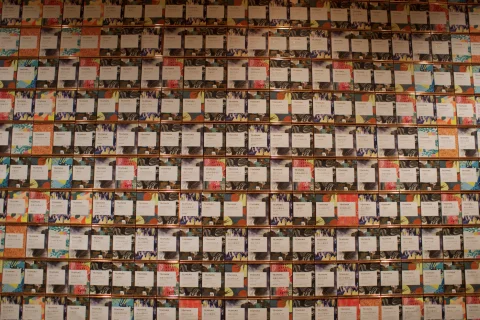
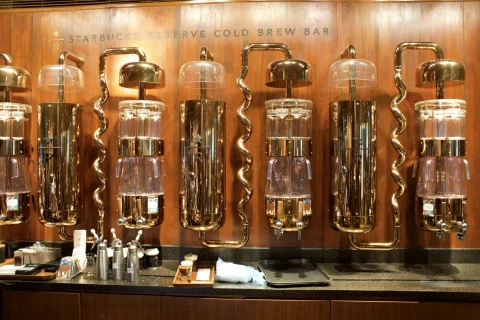
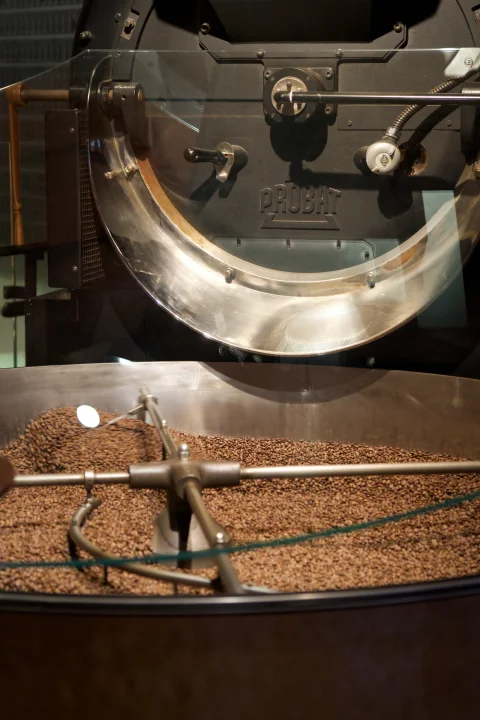
Instead, we visited the huge Starbucks Reserve Roastery. Across two floors there were counters making coffee in different ways, elaborate glass equipment, things heated over flames, and enormous machines roasting beans in front of visitors. It was beautifully put together, almost an industrial exhibition about coffee. I admired it for a while, looked at the prices and bought nothing.
Next door stood a Louis Vuitton installation shaped like a ship. The monogram has always struck me as an efficient way to remind people how expensive your bag was. Still, I had paid 550 yuan for a teapot I’d later seen on sale for 100. I was in no position to lecture anyone about value.
We set off towards the former French Concession, following a route from our AI companions. Somewhere we took a wrong turn. It became one of our more successful navigation failures.
Plane trees formed green canopies above cafés, workshops and little shops. We stopped wherever we wanted, went inside, looked around and carried on. Eventually we noticed we were heading the wrong way, turned round and enjoyed the walk in the other direction.
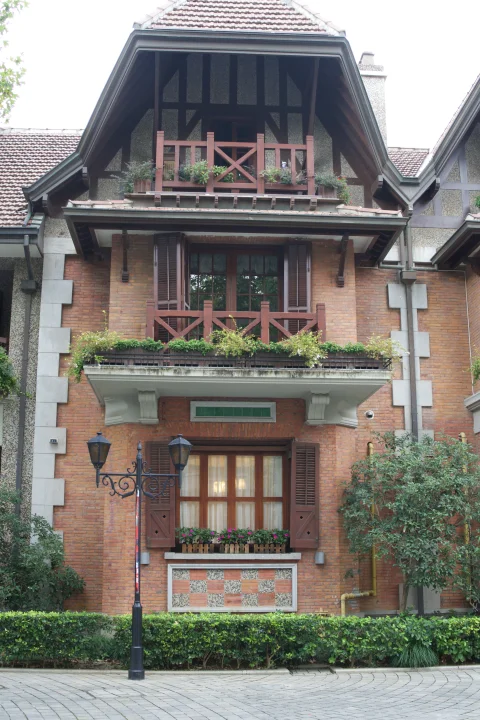
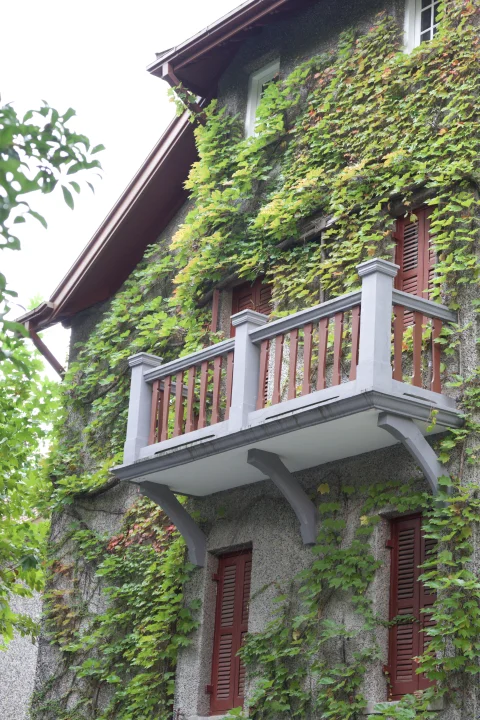
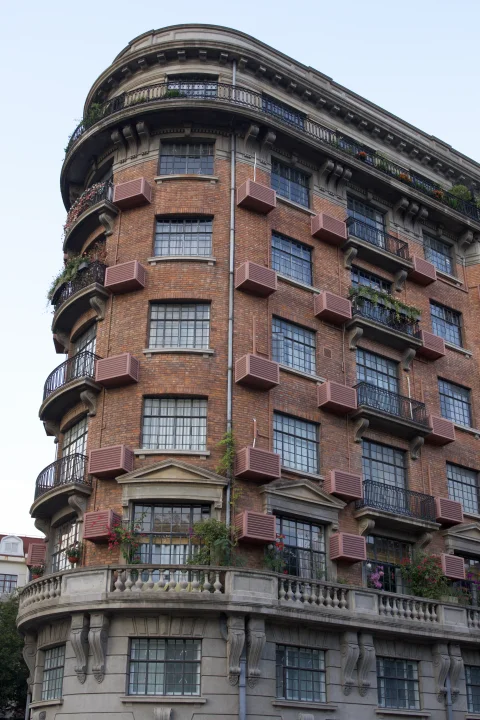
We finally reached Wukang Mansion, a red-brick apartment building completed in 1924, with the distinctive pointed corner that appears in so many photographs. In a nearby shop we found two little black guardian lions I really liked. We laughed at a plush pig that oinked, but left it behind: we already had a pig cushion from Miniso. There are limits to how many pigs two people can bring home in a suitcase, though I am reluctant to establish exactly where those limits are.
By late afternoon, we knew we had no energy left for the tea market we had also hoped to visit. I wanted time to taste and browse, not just tick another thing off a list. We skipped it.
We went back for a look inside the Tesla showroom we’d noticed on the way. The interiors seemed terribly bare: a steering wheel and a screen, then not very much else. I remembered driving a Volkswagen in which even adjusting the air conditioning required leaving the navigation screen. I silently wished future Tesla owners good luck. There was an Optimus robot standing by the window, but it did not do anything, so it was difficult to feel especially impressed.
With an early flight ahead of us, we went back for our luggage and set off for the airport hotel. The metro journey took more than an hour, which gave us a fair idea of just how big Shanghai is.
We spent some of our remaining small change on a flat white for the next morning. I promised to share it with Lena. An investment in getting both of us out of bed early.
Going Home, via Xining
We got up painfully early. Our hotel was only about a hundred metres from the terminal, and for once, check-in and all the airport checks went smoothly.
We’d had more trouble packing. Lena’s Dyson, the brick from our shopping day, had required its own travel arrangements. We needed to be able to show it for the tax refund, so we couldn’t put it in our checked luggage. After a lot of repacking, Lena ended up carrying her expensive new machine in a Wildberries shopping bag. Wildberries is a Russian online retailer. In case anyone was wondering where we were from. My backpack held everything else and was getting suspiciously close to its weight limit.
Our flight from Shanghai to Urumqi included a stop in Xining. Bad weather in Urumqi delayed the onward flight by several hours.
We had a connection to Moscow to catch, and Lena was beginning to feel ill. I started checking alternative flights and found prices that made me feel considerably worse. The airline offered instant noodles as an apology. We couldn’t even retreat into the World of Luxury and Comfort: the lounge wanted a boarding pass from Xining, while ours said Shanghai to Urumqi.
The next delay came after we landed in Urumqi. The plane seemed to taxi for an age, while every minute ate into the time left for our connection.
Inside the terminal, however, someone had arranged for us to be fast-tracked through the airport checks. We hurried from checkpoint to checkpoint in what felt like seven minutes. I’d never made it through an international airport so quickly in my life. We reached our gate in time.
And directly opposite the gate was the tax refund desk.
I took this as a sign that our luck had changed. Boarding was still some way off, so we joined the queue. The man at the only open window had a stack of refund forms. While we waited, we kept looking back towards the gate. The Dyson was right there in its Wildberries bag, ready for inspection. When we finally reached the window, we were told to go to customs for an additional inspection.
The clerk seemed admirably committed to saving public money. One more errand, one imminent boarding call, and one refund safely unclaimed.
We did, at least, catch the plane to Moscow.
Back Home
When I think back to China, I see those first columns at Zhangjiajie rising through the mist, with the two of us trying to photograph each other beneath them. Then the almost empty wall in Xi’an, stretching away above the city, and Nanjing Road’s lights and crowds. I wanted to keep looking, walking a little farther, taking one more photograph.
I still mourn my power bank. The teapot remains a monument to starting a collection before acquiring any expertise.
I keep remembering Lena pulling pearls from a mussel and squeaking over her bracelet, Katya handing round something local to eat, and the absurdity of a toad and a beetroot discussing our complaint by email.
I’d happily go back to China. For now, though, I’m glad to be home with Lena. I like seeing new places, and I also like the life we have here: our familiar walks, my desk, and a bed that doesn’t require a timetable, a cable car or six buses to reach.