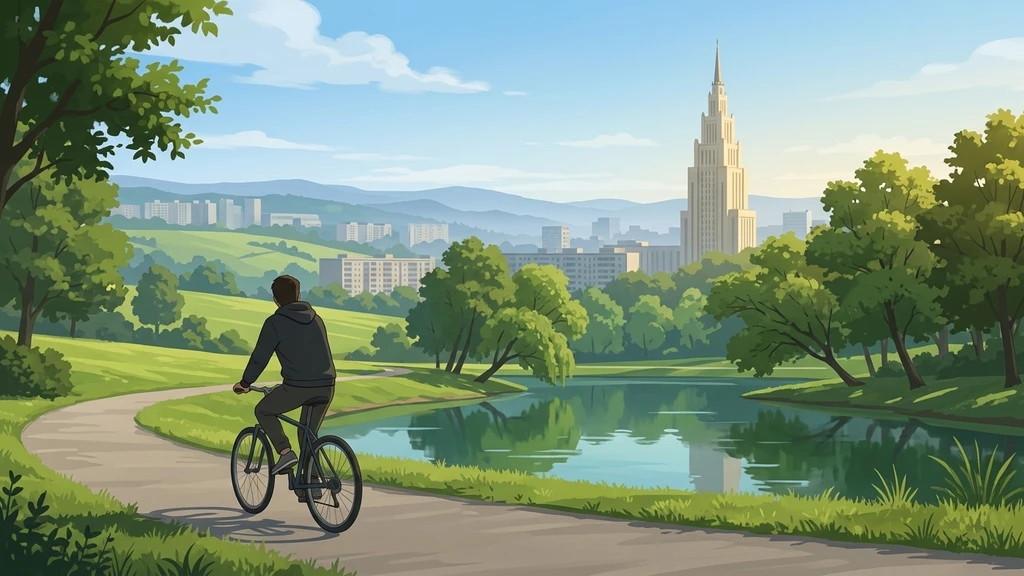
Before I started cycling, Moscow felt like a video game where the metro and transit worked as fast travel. You duck underground at one spot, pop back up at another, and have almost no sense of what lies in between. The city breaks into isolated islands around stations, with no real feel for how those locations actually connect.
My first sortie on a bicycle happened back when I lived in Odintsovo, where commuting into Moscow usually meant Mozhayskoye Highway traffic jams or stuffy commuter trains. That ride was rough: a long haul, crossing the MKAD ring road, riding along the highway in traffic. It wasn’t something I wanted to repeat every day, yet simply making it there changed how I saw things: if I could pull it off even like that, then it was actually possible. The real riding started after I moved to Krylatskoye. There was greenery all around, and the commute to work near Kievskaya was only about 12–15 kilometers each way.
From April through late November I biked in every workday, racking up thousands of kilometers a year. I carried a small portable speaker, turned down low enough that only I could hear it, rode with heavy metal playing and the wind in my face, and for the first time in my life genuinely looked forward to the commute. At the end of the ride I parked the bike right against the fence outside work, which back then was a converted railway car.
I can’t take the exact same road every day; I need variety. So I spent a long time hunting for different routes to Kievskaya until I settled on three or four main ones. I tried to steer clear of major highways, threading through parks and past ponds instead. From those rides I still picture Krylatskiye Hills, Rublyovskoye Highway, Filevskaya Embankment, and Naryshkinsky Pond most clearly, where beautiful trees lean right down over the water and reflect in its surface.
Over time, commuting turned into steady exploration. On two wheels it’s easy to scratch your curiosity: “What’s behind that building? Where does this street lead?” You just turn and check. The cost is tiny. On foot, detours like that eat up too much time so you usually walk right past; on a bike, you can duck down a side street almost for free.
Out of those small detours, the city gradually stitched itself together in my head. There was no single turning point where the whole picture suddenly clicked. The disconnected pieces just started meeting ride by ride. I had always tended to note obvious landmarks like tall buildings automatically and could usually point in the right direction. Cycling put that habit to real work: I picked out landmarks on the map and used them to tell where I was. One of my main beacons was the Edelweiss tower near Slavyansky Bulvar. It has an unmistakable silhouette and stands out from a long way off.
At some point I caught myself holding a hefty sector of Moscow in my head like the palm of my hand. I could mentally trace a route from one point to another and immediately see alternate ways if I felt like riding differently. People often say Google Maps dulls your sense of direction (I even read an article about it back then). Maybe it does for some, but for me it only helped: I checked the map only when I had no other way left.
Once that familiar sector stopped being a scatter of metro stops, I wanted to ride further afield. At the height of my cycling phase, before I started riding in winter, I used to watch GoPro videos on YouTube of some guy cycling around Moscow. As I remember it, he had set himself the goal of documenting every crossing over the MKAD. Later on, winter came into the picture too, and I got myself studded tires. Back then, any walk on foot felt like a missed chance to be turning pedals.
Eventually I switched jobs and started riding into a different, less scenic sector of the city. Once I went remote, those commutes stopped altogether. These days I walk more; that’s how habits change. Still, every now and then I miss that feeling of an unexplored Moscow, and I want to head out and discover new districts all over again.